
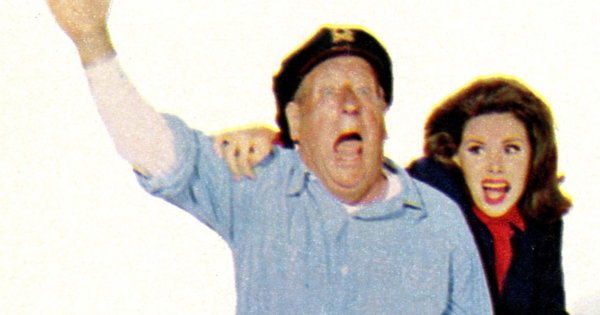
The Baileys of Balboa stars Paul Ford as a widowed curmudgeon who runs a charter boat service around the affluent island community of Balboa. John Dehner, Sterling Holloway, Les Brown, Jr., and Clint Howard co-star. The sitcom ran for 26 episodes on CBS during the 1964-1965 season.
Filming On An Island (Sort Of)
When Paul Ford was approached by CBS in early 1964 to star in The Baileys of Balboa, he was starring in a Broadway play called Never Too Late, which had opened in November 1962. From 1955 to 1959, he had co-starred in The Phil Silvers Show, also on CBS, as Colonel John T. Hall. With his contract set to expire on June 1st, it was the perfect time to return to television. Ford told Val Adams of The New York Times “we’re negotiating. No deal has been set, but something may happen soon” [1]. Despite not having its star, CBS already had the series scheduled — it would air Tuesdays from 9:30-10PM — and planned to start production in July.
According to Michael Dann, the network’s vice president of programs, CBS would lease an island in Newport Harbor, California near the neighborhood of Balboa (and the nearby Balboa Island) where it would film portions of the series [2]. When CBS formally announced its 1964-1965 schedule in March 1964, Ford had been signed to star and The Baileys of Balboa was one of fourteen new and returning comedies on the network [3]. The series was ultimately given the Thursday 9:30-10PM time slot opposite the second installment of ABC’s prime time soap opera, Peyton Place and NBC’s Hazel.
In April, The Hartford Courant reported that Ford would begin production on The Baileys of Balboa immediately after leaving Never Too Late on May 30th, then leave for a brief vacation in England, and then return to continue filming [4]. Reportedly, his contract guaranteed him ten days vacation following every seven weeks of filming [5].
CBS decided against leasing an entire island. In order to film on the actual Balboa Island an unusual production schedule was devised. Six weeks were spent at the CBS Studio Center in the San Fernando Valley, filming interiors, followed by one week on Balboa Island filming exteriors. According to TV Guide, sets for the series had to be rebuilt and then torn down every time production began on Balboa Island [6]. Producer Bob Sweeney explained that “this location makes it tough. We shoot six shows in the studio in Hollywood. In every one of them, we leave a few bits to do down here. And these bits must match the studio stuff exactly. But we must do it this way to live up to our promise of doing a show that escapes from the usual three-wall set” [7].
Filming the opening credits to the series proved equally as challenging. Originally, they were supposed to feature co-star Judy Carne water skiing. Only Judy Carne couldn’t water ski. TV Guide reported that two days were spent trying to get the shot. Said Carne, “I guess I managed to get up a little, but I looked so horrid they decided to just let me wave from the back of the boat [8]. (According to the TV Guide article, Carne was ultimately seen waving while standing on a beach, although she doesn’t appear in the opening credits as broadcast.)
Also potentially problematic was Ford’s dislike of fishing. As he explained in September 1964, “the idea of taking a hook out of a fish’s mouth appalls me. So far, we’ve skirted this particular type of scene, but one of these days, I’m afraid, the director will insist that I unhook a fish” [9].
A Little Class Warfare
In The Baileys of Balboa, Paul Ford’s character was named Sam Bailey. He was widowed and as blue collar as they came, the skipper of a charter boat called “The Island Princess” while also operating Bailey’s Landing, a sort of bed and breakfast. He lived in the middle of an island paradise populated by stuffy aristocrats. As such, the series would draw its humor from the conflict between Ford and his neighbors, particularly his nemesis “Commodore” Cecil Wyntoon (played by John Dehner), head of Balboa’s snooty yacht club. The two did not get along. Wyntoon was eager to acquire Sam’s property to expand the yacht club. Ford referred to his character as a “salty individualist” who is constantly at odds with his “sophisticated neighbors” but explained that in real life, if he had a problem with a neighbor he’d just move away [10].
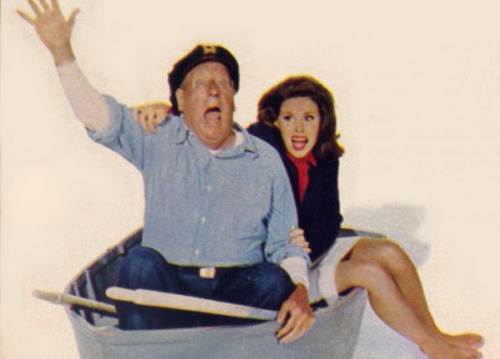
Paul Ford and Judy Carne as Sam Bailey and Barbara Wyntoon – September 19th, 1964
Copyright © TV Guide, 1964 [1]
Sterling Holloway played Buck Singleton, the sole member of The Island Princess‘s crew. Buck lived in a van and also helped out at Bailey’s Landing, cooking and doing odd jobs. Les Brown, Jr. and Judy Carne co-starred as Jim Bailey and Barbara Wyntoon, the respective children of Sam Bailey and Commodore Wyntoon. Jim worked with his father at Bailey’s Landing and had fallen in love with Barbara, who returned to the island from boarding school a beautiful young woman, nothing at all like the girl he remembered. Carne made her first appearance in the October 8th episode, the show’s third. Both Sam and Wyntoon frowned upon the romance, neither wanting their offspring associating with the enemy.
Clint Howard rounded out the cast, playing young Stanley, an obnoxious pre-schooler who lived near Sam and intruded upon his life at inopportune times. John Banner and Howard Freeman had recurring roles; their characters were named Hans and Langley. Michael J. Pollard appeared in two episodes during the winter of 1965 as Sam’s brainy nephew, Chester, whose father was concerned that his son was spending too much time in his lab dabbling in chemistry and not enough outside in the sun with other young people.
Life on an Island
The island of Balboa was surrounded by beautiful waters, in which the annual Balboa Island Swim Race took place. Jim was heavily favored to win until Commodore Wyntoon found a ringer. There was also a park, where Sam and his Balboa Marching and Grunion Hunting Society Military Band attempted to put on a concert only to discover it was under construction. There was even an annual Balboa-to-Laguna Antique Car Race, which Buck and Sam entered, in an automobile with a top speed of 11 miles per hour.
A number of episodes involved Commodore Wyntoon’s various schemes to undermine Sam. For example, in one episode he forges a map depicting the location of a sunken Spanish ship loaded with treasure, hoping Sam will spend all his money trying to recover it. In another, he also conveniently discovered that the Balboa Indians still had a claim to Sam’s land and he also happened to have a Balboa Indian at the ready. Sam and Wyntoon actually worked together in one episode, putting aside their differences in an attempt to keep Jim and Barbara apart.
Several other episodes were centered on young Stanley. He runs away in one episode because he’s sick of school and wants to become a sailor. In another he begins boarding at Bailey’s Landing only to get kicked out of nursery school. And in yet another, his story about a sea monster becomes a bit too real when a sea monster appears in the waters of Balboa.
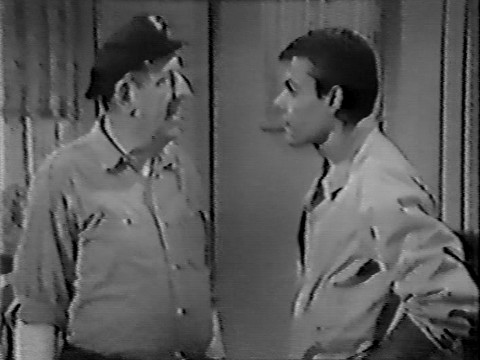
Paul Ford as Sam Bailey and Les Brown, Jr. as Jim Bailey
Other episodes had typical sitcom plots: Sam accidentally purchases a stolen turkey; an old friend of Buck’s with a bit of a gambling problem comes looking for work; Buck and Sam get into an argument over which late-night movie to watch; Sam and Jim get into an argument and Jim quits, leaving Sam searching for someone to replace him; Sam takes over cooking duties in the face of rising food costs, thinking he can make tasty meals without breaking the bank; faced with mounting repair bills, Sam decides to sell out;
Raquel Welch guest-starred in one episode as Chester’s girlfriend, who he wants to keep dating despite Sam’s disapproval. In order to trick Sam into letting the two be together, Chester and Jim come up with a plan to make Sam think Chester is invisible. Other guest stars included Leonard Stone, Rosemary De Camp, Ellen Corby, Larry Storch and Dick Gautier.
Low Critical Opinion, Low Ratings
Jack Gould of The New York Times was less than impressed with the premiere of The Baileys of Balboa, writing that “the script was a strained and mechanically rendered narrative” [11]. Gould did have kind words to say about Paul Ford, however, suggesting he could “carry this series by just being himself” and noting that “it would be a pity if brittle antics were to overshadow the underlying warmth of Mr. Ford.” Rick Du Brow of UPI also praised Ford, suggesting “if you don’t expect too much, and simply appreciate the pleasure of Ford’s company, no matter where, you will get a few chuckles” [12]. Cynthia Lowry of The Associated Press was more positive, stating that “after a short shake-down cruise, this may prove to be a pleasant, warm series” [13].
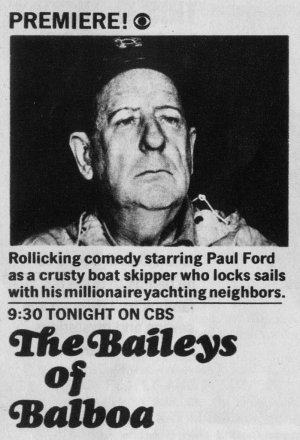
Television Magazine surveyed 17 television critics in a November 1964 article about the new season [14]. Of the 16 who reviewed The Baileys of Balboa, only three called it good. Six called it bad and the remaining seven were indifferent. Paul Ford was lauded universally, with Frank Judge of the Detroit News arguing “if somebody will give Paul Ford better scripts he’ll turn this thing into a hit show” and the San Francisco Chronicle‘s Terrence O’Flaherty writing that “Ford’s face is his fortune, and the show’s director used closeups of it whenever there was nothing else to look at–which was often.”
Rex Polier of The Philadelphia Bulletin also praised Ford, calling him “talented and funny” but the series itself “a typically soupy, sentimental Hollywood situation comedy.” Strongly falling into the indifferent camp was Del Carnes of the Denver Post called it “cute, but certainly no knee slapper in the laugh department.” One of the more negative reviews came from Jack E. Anderson of the Miami Herald who wrote “its first episode, I’m afraid, came across so flatly as to mark it as one of the season’s expandable series. It has a good cast and they try very hard to make something of a thin idea–but futilely.”
Airing Thursdays from 9:30-10PM, The Baileys of Balboa faced Peyton Place II on ABC and Hazel on NBC. It didn’t stand a chance. The premiere episode (broadcast September 24th) ranked third in the time slot based on a 26-city Trendex report, which gave it a 10.5 rating and a 20.8 share; Peyton Place II more than doubled its audience, drawing a 24.5/48.5 [15]. The October 8th episode fared slightly better based on Arbitron numbers, with a 13.0 rating and a 23 share, but again it ranked third [16]. The November 5th episode fared even worse, dropping to a 10.7 Arbitron rating and an 18.0 share; it was the lowest-rating program on the air that evening [17].
On December 7th, the national Nielsen report for the two-week period ending November 22nd was released. TV Guide called it the “$100,000,000 Report” and the first conclusive Nielsens of the new season due to the fact that previous reports had included far too many pre-emptions for political programming. But this report would indicate what viewers liked and what they didn’t. They didn’t like The Baileys of Balboa, which was one of 20 programs to receive lower than a 17 rating, which TV Guide noted had been considered a “passing grade” in previous season [18].
Based on that report, CBS executives made extensive scheduling changes. On December 12th, The New York Times reported that CBS planned to move Password and The Baileys of Balboa to Fridays from 8:30-9:30PM beginning January 1st, 1965 [19]. On December 28th, however, Broadcasting revealed that both shows would remain in their Thursday time slots at the urging of the shows’ advertisers (The Baileys of Balboa was sponsored by Reynolds Metal and Philip Morris) [20]. For the two week period ending January 24th, 1965 the series actually ranked dead last in the Nielsen ratings [21]. The Baileys of Balboa was canceled in February of 1965 [22]. The last first-run episode was aired on April 1st, 1965. The following week, Celebrity Game with Carl Reiner took over the time slot.
According to the national November-December Nielsen ratings, The Baileys of Balboa ranked 84th out of 96 programs on the three networks [23]. Among the twelve programs it ranked higher than were The Outer Limits, The Joey Bishop Show, Mickey and That Was the Week That Was. It proved weaker than its lead-in, Password, which ranked a poor 75th. It was clobbered by Peyton Place II, which ranked 7th, as well as Hazel, which ranked 43rd. For the evening as a whole, CBS ranked third with a 17.4/29 rating/share; ABC was first with a 21.4/35 and NBC second with an 18.8/31 [24].
Involvement In A Lawsuit
Following the show’s cancellation, a CBS stockholder accused the former president of the network, James Aubrey (who had resigned on February 27, 1965), of favoring Keefe Brasselle’s Richelieu Productions, the company that produced the The Baileys of Balboa as well as The Reporters and The Cara Williams Show. The Wall Street Journal, reporting on the lawsuit in March of 1965, incorrectly stated that The Baileys of Balboa was “in the top 10 in popularity” [25].
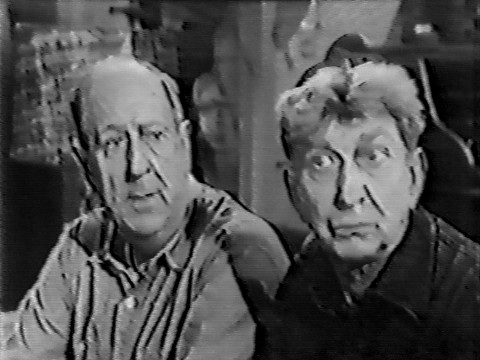
Sterling Holloway and Paul Ford as Buck Singleton and Jim Bailey
According to The New York Times, the suit charged that “while Mr. Aubrey was president of the company he selected shows offered by Richelieu Productions, Inc., for presentation without the submission of the customary pilot films, and ordered them into prime time slots” [26]. The suit itself declared that “in 1963 Aubrey and Richelieu entered into a conspiracy to so conduct the programing and purchasing of shows by C.B.S. as to most advantage said conspirators, directly or indirectly, without regard to the best interests of C.B.S.” [27].
Richard Oulahan and William Lambert, in a September 10th, 1965 LIFE article, wrote that “announcement of the three CBS compacts with Brasselle set off a riot of industry gossip–and opened the final act of Aubrey’s decline and fall” [28]. The article, titled “The Tyrant’s Fall That Rocked the TV World,” described how said industry gossip began “hinting at conflicting interests and hidden partnerships with Richelieu” [29].
An investigation was ordered by the FCC and conducted during the summer of 1964 by an outside law firm; the LIFE article quotes a pair of unnamed FCC officials as calling the report “a self-serving document” and “strictly a unilateral investigation” [30]. For the record, The Reporter ended its run in December of 1964 after 13 episodes while both The Baileys of Balboa (26 episodes) and The Cara Williams Show (30 episodes) lasted the entire season. In October 1969, Broadcasting revealed that Aubrey had been sued by not one but two stockholders and that CBS had been named in both. The two suits were merged and ultimately dropped after Aubrey agreed to give up his option to purchase 3,000 shares of CBS [31].
Sold Internationally
Broadcasting reported in June 1964 that The Baileys of Balboa had been sold to CTV Networks in Canada where it would be sponsored by American Home Products and Procter & Gamble [32]. And in August 1964, Broadcasting revealed that the series would also be seen in Australia, having been purchased by Austarama Pty. Ltd, part of CBS Films’ largest Australian sales to date.
Works Cited:
2 Ibid.
3 Adams, Val. “News of TV-Radio: A Laughing Matter.” New York Times. 15 Mar. 1964: X19.
4 “TV Notes.” United Press International. Hartford Courant. 12 Apr. 1964: 4H.
5 Grant, Hank. “The TV News Beat.” Hartford Courant. 13 Sep. 1964: 5I.
6 “Let’s Get the Show on the Road.” TV Guide. 9 Jan. 1965: 11.
7 Keiner, Dick. “New Half Hour Comedy: Baileys of Balboa Present Weekly Television Series.” Florence Times. [Florence, Alabama]. Newspaper Enterprise Association. 13 Sep. 1964: 32.
8 “Making Quite a Splash in a New Series.” TV Guide. 22 Aug. 1964: 10-11.
9 Grant, Hant. “Acting Opened Rich New World for Paul Ford.” Hartford Courant. 27 Sep. 1964: 9G.
10 Ibid.
11 Gould, Jack. “TV: Horribly Engaging.” New York Times. 25 Sep. 1964: 81.
12 Du Brow, Rick. “Worth a Look: Comedies About Monsters Pleasant Change of Pace.” Eugene Register-Guard. [Eugene, Oregon]. UPI. 25 Sep. 1964: 7A.
13 Lowry, Cynthia. “Television: Horros! Munsters Are Here.” Free Lance-Star. [Fredericksburg, Virginia]. Associated Press. 25 Sep. 1964: 2.
14 All review excerpts from the November 1964 issue of Television (“Consensus,” Page 74).
15 “CBS takes lead in Thursday ratings.” Broadcasting. 28 Sep. 1964: 9.
16 “Thursday night still literally in the air.” Broadcasting. 12 Oct. 1964: 10.
17 “Thursday night Arbitrons.” Broadcasting. 9 Nov. 1964: 9.
18 Harding, Harry. “For the Record.” TV Guide. 19 Dec. 1964: A-1.
19 Adams, Val. “C.B.S. Shuffles Show Schedules.” New York Times. 12 Dec. 1964: 63.
20 “Networks taper off on lineup changes.” Broadcasting. 28 Dec. 1964: 36.
21 “For the Record.” TV Guide. 20 Feb. 1965: A-3.
22 Adams, Val. “C.B.S. Fall Slate Omits 14 Shows.” New York Times. 4 Feb. 1965: 63.
23 “Hindsight 64/65.” Television. Mar. 1965: 34.
24 “Hindsight 64/65.” 32.
25 “CBS Holder Files Suit Against Former Chief of Firm’s TV Network.” Wall Street Journal. 30 Mar. 1965: 13.
26 “Aubrey Is Accused In Stockholder Suit.” New York Times. 30 Mar. 1965: 93.
27 Ibid.
28 Oulahan, Richard and Lambert, William. “The Tyrant’s Fall That Rocked the TV World.” LIFE. 10 Sep. 1965: 98.
29 Ibid, 101.
30 Ibid, 102.
31 “Aubrey vaults to top again.” Broadcasting. 27 Oct. 1969: 65.
32 “U.S. TV shows scheduled for Canadian networks.” Broadcasting. 22 Jun. 1964: 76.
33 “Sullivan show scores 1st overseas sales.” Broadcasting. 31 Aug. 1964: 72.
Image Credits:
2 From TV Guide, September 19th, 1964, Page A-64.
Originally Published June 11th, 2003
Last Updated April 17th, 2018


Jim Aubrey, “The Smiling Cobra” of CBS {as well as its president and chief programmer}, personally ordered “THE BAILEYS OF BALBOA” [without a formal pilot episode] because HE believed he could create a “better” version of “GILLIGAN’S ISLAND” than Sherwood Schwartz could. Aubrey LOATHED that show- he kept saying to Schwartz, “Get those castaways off that fucking island!!”, and didn’t like the fact that the series’ co-sponsor, Procter & Gamble, practically forced him to keep it on his 1964-’65 schedule, or they claimed they’d pull all of its advertising- and their daytime soaps- off CBS and move them elsewhere. A similar threat was also instigated when Aubrey intended to move “PETTICOAT JUNCTION” off Tuesdays (so he could schedule “THE BAILEYS OF BALBOA” after “THE RED SKELTON HOUR” that fall) to Monday nights for the fall of ’64, but P&G said they preferred to follow Skelton, and that either “PETTICOAT JUNCTION” stayed in “its” time period on Tuesdays, or…Aubrey also hated to deal with sponsors and agents, believing his “direct” method of scheduling TV series was better.
Anyway, Aubrey believed the idea of a charter boat captain operating in a marina was, in his humble opinion, a better idea for a situation comedy. So, he got his old friend Keefe Brasselle, who was operating a production company called “Richelieu Productions” [named after his favorite New York restaurant] to produce a show along the lines of his suggestion {Aubrey, as mentioned in the article, also bought “THE REPORTER” and “THE CARA WILLIAMS SHOW” from Richelieu for CBS’ 1964-’65 schedule WITHOUT formal pilot films, either}. When Aubrey was removed from his position at CBS at the end of February 1965, “THE BAILEYS OF BALBOA” went with him.
The other thing that should be mentioned in connection with all this is, one of “Gilligan’s Island’s” main financial backers was the former star of “Sgt. Bilko,” Phil Silvers, via his production concern Gladasya Productions (Silvers would play the title character in a third-season “Gilligan” episode, “The Producer”). In that context and with this background, it sounds like the signing of Paul Ford (who’d played Bilko’s nemesis, Col. Hall) as Sam Bailey was also something resembling a form of revenge on Aubrey’s and/or Brasselle’s part.
This was a funny show that deserved better! Paul Ford was great as was Sterling Holloway, John Dehner and Les Brown Jr.
Sadly, all that we got was crap (and when mentioning this series, I do indeed mean crap) like Gilligan’s island. The Baileys Of Balboa may not have been as well executed as it should have, but at least there’s the germ of an idea that would work in real life (class warfare between a working class man and his son and a wealthy man and his daughter) versus the stupid idea of a tour boat somehow ending up on a deserted island after a storm strands it, and with the radio busted and unworkable plus all of the other bull#@!% that made up Gilligan’s island.
And to think that people want to blast current (North) American TV shows of the 1990’s, 2000’s and 2010’s simply because of language, frank depictions of sex, correct depiction of technical terms, alternate sexualities (LGBT lives), more inclusion of women and minorities and a whole host of other things that make up real life in the modern world.
I remember watching this show when i was ten and enjoyed it very much. I too would like to get copies of any episodes. Of the many TV shows i did watch and have since bought episodes, i find I was not off the mark of most of them. If episodes are available, I beoieve I’ll find that ths was as enjoyable as when i first saw it.
Unless CBS decides to put this show on DVD via their version of Warner Archive, I doubt that it will happen (although I suppose this company or this company could be persuaded to put the show on home video.) The only other option is for this show to be on any of the OTA digital sub channels but there might not be enough interest (plus this show has no video masters, it never having been rerun at all.)
I THINK THAT THE TV EXECITIVES MAD A BAD DISICION WHEN THEY CANCELD BAILEYS OF BELBOA IT WAS A GOOD SHOW I ENJOY WISHING IT ON YOUTUBE.
Having worked at CBS-Tv for a bit of time and heard many of the “Smiling Cobra” stories, I can only surmise that Mr Aubrey’s only problem was a lack of ego.
Loved the show when I was 7. Saw a bunch of them at 27, then not so much. Judy Carne must have seen that the show stunk because she left after a handful of episodes. By the midway point of the season, she’s not even in the opening credits any more.
“the idea of taking a hook out of a fish’s mouth appeals me”
don’t you mean appalls me?
Very interesting. The clips seem to reveal the show as fairly garden variety? However, in color, it probably would have done better.
One of the three shows Keith Brasselle produced for CBS in the 1964-65 season, the drama series “The Reporter”, was supposedly pretty good.
But it got killed in it’s Friday night at 10 P.M. (Eastern/Pacific) time period by “Twelve O’Clock High” and Jack Paar’s prime-time variety show on NBC.
The life story of 1960’s CBS-TV executive Jim Aubrey would make both a great book and a great TV miniseries.
How about Tom Cruise as Aubrey in that TV miniseries??
The concept was already carried out in fiction as the novel (and movie based on said novel) The Love Machine.
Small (if belated) correction:
Judy Carne did appear in the opening credits during the first half of the season; she left the cast about midway through the run.
The credits you’ve imbedded come from the second half of the season, after she left (which may have been another factor in the brevity of the run).
Not long after the events covered herein, Jim Aubrey was the subject of two thinly-disguised “a clef” novels:
The Love Machine, by Jacqueline Susann;
The CanniBalS, by Keefe Brasselle (yeah, him).
The Susann novel was filmed, with John Phillip Law as the Aubrey character.
The Brasselle novel – well, he didn’t get killed, probably because of his ‘alleged’ Mob connections.
So there too.
Is the show available on DVD? I can’t seem to find it but perhaps someone has all the 26 episodes?
No, it isn’t, although you could request for it to be on DVD at Amazon, or hope that either VEI or Timeless would put it on home video, or that CBS puts it on home video via their version of Warner Archive.
and at such a late date here//the appearance of Les brown jr` is a true curtiosity—-.His dads band /musical fame group employed our high school band teacher DONALD MAIRS who was also brassman for Frank Comstock//—-Comstock did all Dragnet stuff**etc.. Its no surprise that Mairs protige was ALAN SILVESTRI who shot to world wide fame scoring BACK TO THE FUTURE==========!! funny you should ask^,,alan’s grade school music teacher was also this very author;’s/ *** Meanwhile Les;s career hardly took off.. with maybe
one appearance in a Beach party teen movie and did not click,,, as for Carnes” career? dont even mention it/////