
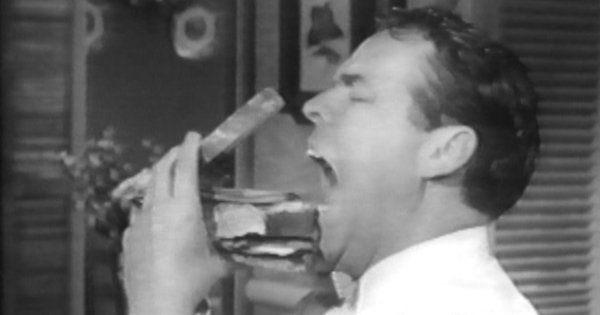
Both NBC and CBS tried, and failed, to bring Chic Young’s long-running comic strip Blondie to television. NBC’s version ran for 26 episodes in 1957, with Arthur Lake and Pamela Britton. The CBS version ran for 13 episodes during the 1968-1969 season, starring Patricia Harty and Will Hutchins.
From Newspaper To The Big Screen To Radio
Chic Young’s classic comic strip was began its run in newspapers in September 1930, distributed by King Features Syndicate. It chronicled the life of flapper Blondie Boopadoop, who married her boyfriend Dagwood Bumstead in 1933. Dagwood, whose fondness for towering sandwiches defied the laws of physics, was disowned by his wealthy family for marrying Blondie and soon took a job at the J. C. Dithers Construction Company to pay the bills.
Much of the humor in the strip came from the conflict between Dagwood and Dithers. As the strip’s popularity grew it began to branch out into other mediums. A movie adaptation, simply titled Blondie, was released in November 1938 with Penny Singleton as Blondie and Arthur Lake as Dagwood. It would be followed by an astounding 27 sequels. In July 1939 a radio version premiered, with Singleton and Lake reprising their roles.
Both the movie series and the radio show continued throughout the 1940s, with two or three new movies issued each year (with the exception of 1944). The radio show was heard first on CBS, with Camel Cigarettes as sponsor, and later on NBC with Super Suds sponsoring. On March 16th, 1949 The New York Times reported that Singleton had suddenly been dropped from the radio show with no reason given [1]. Actress Ann Rutherford took over as Blondie several weeks later on March 23rd [2].
Additional movies, however, continued to be released with Singleton appearing as Blondie. ABC purchased both the radio and television rights to the Blondie franchise in October 1949 [3]. Singleton began her own radio show, Penelope’s Progress, in June 1950 [4]. The movie series ended April 1950 with the release of Beware of Blondie, the 28th in the series, when Chic Young, King Features and Columbia (the production company) couldn’t come to an agreement regarding a new contract [5]. The radio show ended three months later.
Although its big screen and radio days were behind it, Blondie still had one medium left to conquer: television.
Two False Starts
Stephen Slesinger, the publisher and producer who turned A. A. Milne’s Winnie-the-Pooh into a commercial powerhouse, acquired the television rights to Blondie in 1951. In December of that year he predicted a TV series would be on the air within six months [6]. Actress Jeff Donnell and actor Glenn Vernon screen-tested for the roles of Blondie and Dagwood [7].
In early August 1952, Walter Ames reported that network executives and potential sponsors were meeting in New York City. He also revealed that Penny Singleton would like nothing more than to play Blondie again but not without Arthur Lake as Dagwood and he hadn’t been approached [8]. According to Hedda Hopper, Singleton had actually been asked to star in the television version but turned it down because Lake wasn’t involved [9].
By February 1953, a pilot episode had been filmed with Jeff Donnell and John Harvey as Blondie and Dagwood [10]. Slesinger’s untimely death in December 1953 put an end to the project. A year later, in March 1954, Hal Roach Jr. announced that his studio would be producing 39 episodes of a Blondie sitcom [11]. At the time, Roach was already producing five television shows, including My Little Margie and Racket Squad.
On September 16th, Roach signed Pamela Britton and Hal LeRoy to star in the series. Production on the pilot (titled “One Gun Bumstead”) began a few days later with Abby Berlin directing from a script written by Frank Gill, George Carleton Brown and Harvey Clork [12]. The finished pilot gave teleplay credit to Gill and story credit to Brown.
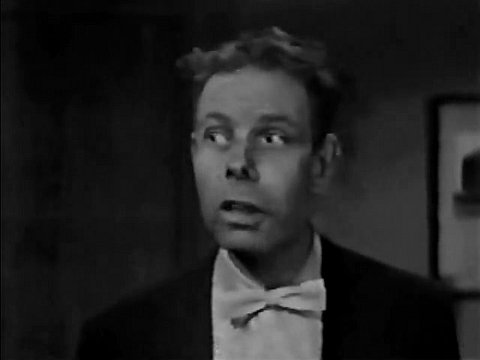
Rounding out the “One Gun Bumstead” cast were Mimi Gibson as Cookie, Stuffy Singer as Alexander, Robert Burton as Mr. Dithers, Isabel Withers as Mrs. Dithers, and Robin Raymon as Tootsie Woodley. Like the earlier pilot starring Jeff Donnell and John Harvey, the 1954 pilot failed to sell.
The NBC Version (1957-1958)
In April 1956, The Chicago Daily Tribune reported that Arthur Lake had returned to the role of Dagwood for a TV series currently in production at the Hal Roach Studios with Pamela Britton once again playing Blondie [13]. Stuffy Singer also returned as Alexander. Ann Barnes took over the role of Cookie.
Two months later, Roach announced that as part of a new “spot sales program” with the Vitapix Corporation, his syndicated version of Blondie had been sold to some sixty-five stations. Wesson Oil Company would co-sponsor the series for total of 52 episodes would be produced with 13 planned repeats [14]. An additional co-sponsor, Sunkist, was added in July [15].
In December, however, the series made the jump from syndication to a network when NBC announced it would premiere Blondie on Friday, January 4th, 1957 at 8PM as a replacement for The Walter Winchell Show. Hal Roach Studios was still producing, but the Toni Company was now sponsoring the series with no word of the Wesson Oil Company, Sunkist or the Vitapix Corporation [16]. Filling out the cast were Florenz Ames as J. C. Dithers, Elvia Allman as Cora Dithers, Hal Peary as Herb Woodley, and Hollis Irving as Harriet Woodley.
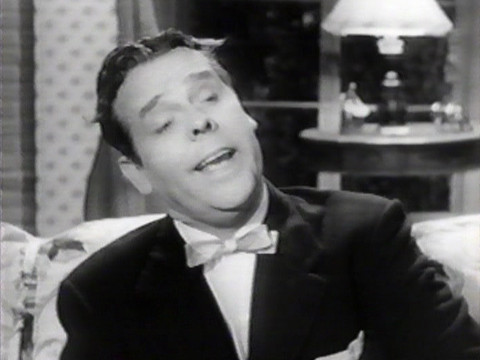
Episodes were simple, with plots reminiscent of the comic strip, often involving Dagwood coming into conflict with Mr. Dithers. Jokes were mild and physical gags were common. In the premiere, Blondie decides that Dagwood deserves to be vice president of the J.C. Dithers Construction Company. So, to help boost his confidence, she sends him a fake telegram stating that his (equally fake) uncle has died and left him well over $100,000. Obviously, things don’t work out the way Blondie had hoped.
Other episodes saw Mr. Dithers and his wife staying with the Bumsteads; Dagwood and Herb feuding over tools; Blondie thinking her marriage isn’t valid due to a missing marriage license; Dagwood quitting because Mr. Dithers won’t give him a raise; Mr. Dithers assuming Dagwood stole money after seeing Blondie on a shopping spree; Dagwood trying to help Alexander woo a classmate.
(One episode used the same script from the 1954 unsold pilot with Hal LeRoy in which Blondie and the kids try to find the perfect birthday gift for Dagwood.)
Whenever Dagwood found himself in trouble (which was often) he would stumble and bumble his way out of it. He was an accident waiting to happen and Blondie always had to keep a close eye on him. A recurring gag involved Dagwood coming home for lunch and Blondie racing into the kitchen to catch the salt and pepper shakers before they crashed to the floor from the force of Dagwood slamming the door shut.
Dagwood’s chaotic nature is best exemplified by the way he runs out the front door in the morning and crashes directly into the mailman, sending letters flying in every direction. This was something readers of the comic strip would recognize and appreciate. Other holdovers from the strip included Dagwood’s love for massive sandwiches and the manner in which he would call out his wife’s name at the first sign of trouble–loudly.
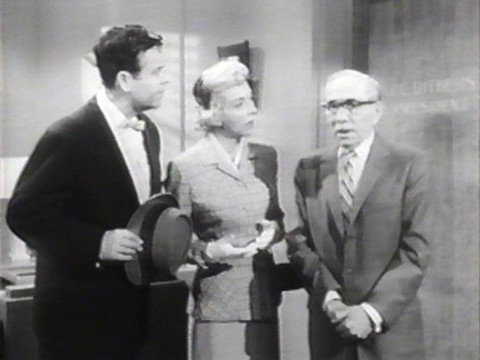
According to critic J.P. Shanley, “viewers who have been amused by the comic-strip and motion-picture capers of Dagwood Bumstead probably will like the television version” as well [17]. Shanley noted that the series wasn’t “taking any liberties with the original formula devised by cartoonist Chic Young. Dagwood still is a dunce with a heart of gold. Blondie continues to give him loyal support in his battles with his crusty employer, Mr. Dithers. The Bumstead household remains a place of sound and fury [18]. The bottom line? “For ‘Blondie’ fans it may be fun. Others are warned to seek their pleasure elsewhere” [19].
Perhaps translating a newspaper comic strip with a single gag into a thirty minute sitcom just wasn’t a good idea. In most ways, though, Blondie was just another standard family sitcom. Name recognition could only take it so far. Arthur Lake gave it his best. He was 33 when he first played Dagwood on the big screen and 52 when he returned for the television series. Still, he managed to pull off a fairly convincing father of two young children.
A total of 26 episodes were produced and new installments continued through the end of June. Repeats were broadcast throughout the summer before Court of Last Resort replaced Blondie on Friday, October 4th, 1957.
The CBS Version (1968-1969)
CBS was in such good shape in December 1967 that it only ordered 10 pilots to consider for its 1968-1969 schedule (by comparison, NBC was looking at 23 projects and ABC 21) [20]. One of those ten shows was a new version of Blondie. The network officially announced its schedule in February 1968 and Blondie was given the Thursday 7:30-8PM time slot [21]. Patricia Harty and Will Hutchins would star as Blondie and Dagwood, with Jim Backus and Henny Backus (married in real life) as as J.C. and Cora Dithers.
The Bumstead children would be played by Peter Robbins and Pamelyn Ferdin. Bobbie Jordan played neighbor Tootsie Woodley (Herb Woodley, it seems, was not present in this version). Speaking of her role in the series, Patricia Harty told The Chicago Tribune that “much of my acting in the Blondie show is done while I’m hovering over the stove. I have no rehearsal problems in the kitchen because cooking is a natural pasttime for me” [22].
However, Harty’s Blondie was no simple housewife. She was a head-strong, independent woman prone, at times, to jealousy. Dagwood was just as clumsy as ever and still managed to rush out the door and crash into the mailman. That was the problem with the series. Wrote critic George Gent:
Patricia Harty as Blondie and Will Hitchins as Dagwood are attractive in the lead roles. But the humor is so very basic that it would appear to be a children’s show exclusively. If the viewer’s taste runs to pratfalls, mistaken identities, smart-alec children and dumb husbands, then this is where to look. He can also watch Dagwwood bowling over the mailman as he rushes to work, trees bending in the wind as he flies by and a jealous Blondie pouring tea in his lap and hitting him over the head with a tray. It’s that kind of show. [23]
Don Page of The Los Angeles Times was even more brutal, calling the series “a witless charade of Chic Young’s Blondie comic strip” and “an unmitigated disaster” [24]. His advice for stars Will Hutchins and Patricia Harty was to change their names before it was too late. “What a price to pay for non-violence,” lamented The San Francisco Chronicle‘s Terrence O’Flaherty [25]. “This time, even CBS-TV went too far,” declared The Washington Post‘s Lawrence Laurent [26].
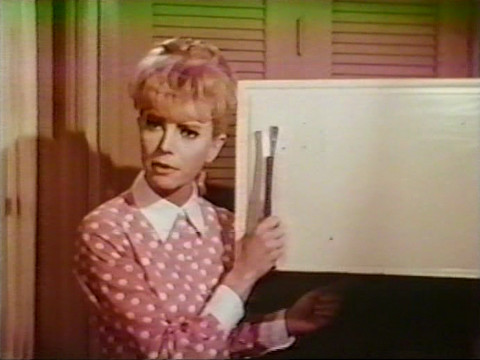
Ben Gross of The New York Daily News, however, had something relatively nice to say about the show. He called it “an amusing charade” [27]. The series premiered on Thursday, September 28th. It was one of three new CBS shows (the other two were Lancer and Hawaii Five-O) to finish premiere week with a Nielsen rating between 15 but below 20 [28]. In other words, it was a mediocre performance at best. In mid-November, CBS discounted rumors that Blondie was nearing cancellation due to low ratings [29].
Later that month, however, Broadcasting reported that “it was considered virtually certain” that Blondie would be cancelled [30]. The 13th and final episode was broadcast on January 9th, 1969. The series was replaced the following week by a new sitcom called The Queen and I. In a review of television in 1968, Hal Humphrey called Blondie the worst situation comedy, writing that it was “an unbelievably crude domestic comedy” [31].
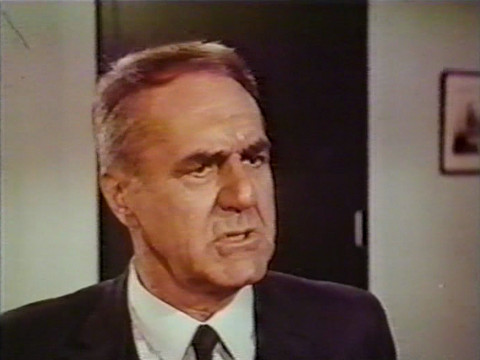
Episodes of the 1968 series were much like those of the 1957 version. In one, J.C. Dithers moves in with the Bumsteads after getting into a fight with his wife. In another, Dagwood is left in charge of the company. Hilarity ensues. Bruce Lee had a role in the final broadcast episode in which Dagwood and Alexander find themselves bullied and Dagwood decides to learn karate. Fans of Bruce Lee have been searching for a copy of this episode for years, to no avail.
Works Cited:
2 “Radio and Television.” New York Times. 22 Mar. 1949: 50.
3 “Radio and Television.” New York Times. 1 Oct. 1949: 28.
4 “Radio and Television.” New York Times. 18 May 1950: 41.
5 Brady, Thomas F. “Hollywood Digest.” New York Times. 25 Jun. 1950: 77.
6 Ames, Walter. “‘Christmas Carol’ Set for TV, Radio; U of Cal. Announces Video Psychology Course.” Los Angeles Times. 19 Dec. 1951: 24.
7 Schallert, Edwin. “New Boy Wonder Quips Along; ZsaZsa Gabor in ‘Moulin Rouge’.” Los Angeles Times. 5 Jan. 1952: 11.
8 Ames, Walter. “Eisenhower Visit Tops Video Fare Tonight; Filmcraft Co. Grabs Mark Twain Material.” Los Angeles Times. 5 Aug. 1952: 22.
9 Hopper, Hedda. “More Film Adventure Due for John Payne.” Los Angeles Times. 8 Aug. 1952: B6.
10 Ames, Walter. “New Orleans’ Mardi Gras on Microwave Today; Byington, Gleason Up for ‘Dixie’ Roles.” Los Angeles Times. 17 Feb. 1953: 24.
11 Pryor, Thomas M. “Hal Roach Plans 2-Fold Program.” New York Times. 24 Mar. 1954: 32.
12 Ames, Walter. “Britton, LeRoy Land TV Roles in Blondie Series; Andy Devine to Be Host.” Los Angeles Times. 17 Sep. 1954: 28.
13 Fink, John. “Where to Dial Today: Dagwood to Try TV This Fall.” Chicago Daily Tribune. 19 Apr. 1956: 76.
14 Godbout, Oscar. “C.B.S. Commissions Three Pilot Films For Comedy and Adventure Programs.” New York Times. 11 Jun. 1956: 43.
15 “‘Snooks’ Revival Planned By N.B.C.” New York Times. 19 Jul. 1956: 55.
16 Adams, Val. “Second Sponsor to Drop Winchell.” New York Times. 17 Dec. 1956: 42.
17 Shanley, J.P. “TV: Genesis of a Show.” New York Times. 5 Jan. 1957: 33.
18 Ibid.
19 Ibid.
20 “CBS-TV plans early lock-up.” Broadcasting. 18 Dec. 1967: 60.
21 Dallos, Robert E. “Few Changes Due in C.B.S. Programs.” New York Times. 19 Feb. 1968: 80.
22 Zylstra, Freida. “TV”s New Blondie Right at Home in Kitchen.” Chicago Tribune. 20 Sep. 1968: B2.
23 Gent, George. “TV: The Dagwood Bumsteads Return.” New York Times. 27 Sep. 1968: 94.
24 Page, Don. “Blondie Series Debuts Over CBS.” Los Angeles Times. 27 Sep. 1968: E25.
25 “Continuing comments on new TV offerings.” Broadcasting. 7 Oct. 1968: 60-62.
26 Ibid.
27 Ibid.
28 “Two new shows rank in top-10 ratings.” Broadcasting. 14 Oct. 1968: 74-75.
29 “A.B.C. to Replace 6 of Its TV Shows With 5 New Ones.” New York Times. 14 Nov. 1968: 95.
30 “CBS-TV puts on rose-tinted glasses.” Broadcasting. 25 Nov. 1968: 52-53.
31 Humphrey, Hal. “TV Today: Columnist Finds Competition Tough for 1968 ‘Worsts’.” Chicago Tribune. 1 Jan. 1969: C13.
Originally Published July 16th, 2003
Last Updated April 18th, 2018


Are there any pictures or video of Daisy, the Bumsteds Dog from the TV series
In the 1957 version there were six dogs. In the opening credits above you can see them at 00:15 to 00:20. In the 1968 version there was just one dog named Daisy (and played by a dog named Daisy). You can see her in the CBS Fall Preview between 00:48 and 00:53.
Was the 1968 version ever sold on VHS or DVD?
As of this year of 2020, this “bomb” has never been released to the public in the VHS, DVD, and Blu-Ray format.
No. Nor was it ever syndicated as far as I know.
There was also a radio version of “BLONDIE”, starring Arthur Lake and Penny Singleton, from 1939 through 1950, appearing over the years on three different networks (CBS, NBC, ABC) for two sponsors [R.J. Reynolds’ Camel cigarettes (1939-’44) and Colgate-Palmolive-Peet’s Colgate Dental Cream and Super Suds detergent (1944-’49); the final season on ABC was “sustaining”]. Penny Singleton was temporarily replaced by different actresses during the 1947-’48 and 1949-’50 seasons.
I believe The Toni Company {Toni Home Permanent, White Rain Shampoo, etc.} and Lorillard Tobacco [Old Gold cigarettes] were co-sponsors of the 1957 version on NBC. Note, in the ’57 opening title, there’s a 10 second “window” that originally featured a “sponsor I.D.” before the opening title flashed on screen. The show’s “theme” was the same one used in Hal Roach Studios’ production of “THE GREAT GILDERSLEEVE”, a radio adaptation originally intended for NBC, but syndicated by them in the 1955-’56 season (39 episodes).
The 1968-’69 edition was produced by Joe Connelly & Bob Mosher [the team who also gave you “LEAVE IT TO BEAVER” and “THE MUNSTERS”].
According to Harlan Ellison in one of his 1968 L.A. FREE PRESS TV columns, CBS had the option of renewing Leonard Stern’s “HE & SHE” for another season…or taking a chance on “BLONDIE” (although I suspect MCA/Universal “leaned” on CBS to accept the latter, since they co-produced the series with Connelly & Mosher, and MCA had a reputation for being “tough” in negotiations with networks for their series).
If I’m not mistaken, Ann Rutherford was one of the replacements for Penny Singleton in the “Blondie” radio series.
Yes, Ann Rutherford was “Blondie” through the radio series’ final season (1949-’50). Arthur Lake’s wife, Patricia Van Cleve, was another “replacement” during the 1947-’48 season, as was Allice White. The reason was simply this- Penny Singleton had simply tired of playing the same character on radio AND in the movies after a decade, and wanted to establish her OWN character in her OWN radio show.
Beginning in 1938 and running for 28 films until 1950 this series is too good to pass up. Relive the adventures with Dagwood, Blondie, Baby Dumpling, Cookie, Alvin, Daisy and the poor mailmen who get bowled over in each episode. For more info go to Blondie and Dagwood: The Movie Series Fan Site at http://www.angelfire.com/tv2/rainbowcountry/blondie.html
Another comic series that always seems to get screwed over in live-action is Archie: There were failed pilots in 1954, 1964, and 1978, and the 1990 TV movie ‘Archie: Return to Riverdale’
J.A.P.
Will Hutchins has a monthly blog posting at westernclippings.com. His April 2010 post describes working with Bruce Lee in the last episode of 1968’s ‘Blondie’. He says when the series was cancelled, Jim Backus said, “Now we don’t have to buy the crew Christmas presents”. The full post:
http://www.westernclippings.com/hutch/hutch_2010_04.shtml
OK, Pat Hardy was cute as Blondie in 68, but this is ANOTHER idea that was 5 years too late, at best. CBS already had their screwball-in-charge with Lucy-but even Conolly/Mosher couldn’t save this turkey
CBS Affilliate KIRO-TV Channel 7 In Seattle Pre-Empted Blondie On Thursday By The Thursday Night Movie It Aired On Friday Night At 7 PM Before the wild,wild west. I Got Sent To Bed From My Dad Without Blondie One Friday Night For Putting Rocks In My Dad’s Gasoline Tank In The 1960’s And I Did. This Series Should Be On DVD From Timeless/Shout. Today’s TV Is Nothing But Junk Now They Show Those Reality Shows As Well As Developmental Disability Shows About Developmentally Disabled People Blowing Up Institutions Or Sheltered Workshops Or Maybe Hitting Bad Staff At Institutions,Sheltered Workshops And Group Homes. We Need Vintage TV On DVD And We Do. Better Than All Those Reality And Developmental Disability Shows. I Watch Classic TV On Youtube Or TV Obscurities. That Is What All We Need.
Hal Leroy appeared as Dagwood in the pilot of the first version.
Is it possible to get the Blondie episode season one episode 13 with Bruce Lee in it ?
The 1957 series has been remastered.
https://www.classicflix.com/products/blondie-the-complete-1957-television-series
Is the movie Blondie supposed to be a comedy?(based on the comic strip)because it seems to be a very long movie and there are funny parts in the movie.Also another thing,which came first? Blondie or I Love Lucy? As a comedy it lacks the funny humor that Lucy Ball has I don’t know this movie could be anything humorous,. Even Shirley temple is funny, so is old reruns of the Gomer piles
Someone should upload the Bruce Lee episode of Blondie onto YouTube & Facebook – the public deserves to see it, after all these years (1968)