
Crazy and outrageous concepts for TV shows are practically as old as television itself. But some TV shows are almost too bizarre to be believed. Read about ten of the most outlandish TV shows of all time, ranging from The Patty Duke Show with its “identical cousins” to the singing police officers of Cop Rocks.
What Makes A Television Show Outlandish?
One could argue that episodes of I Love Lucy tended towards the absurd with plots that found Lucy in bizarre if not downright unbelievable situations. She was locked in a freezer, had a loving cup stuck on her head, filmed a commercial for an alcoholic health tonic called Vitameatavegamin, worked on a chocolate factory assembly line and met Superman. Still, the basic premise was relatively benign.
Both the basic premise and plots of Gilligan’s Island were implausible at best. The castaways, despite only heading out for a three-hour tour, brought along plenty of clothing, and were able to live quite comfortably on their deserted island. The Professor was able to build just about anything they needed using bamboo or coconuts. Worst of all, plenty of guest stars managed to stumble upon the island but the castaways could never get off.
Ten Most Outlandish Television Concepts Ever was a good read, but you didn’t mention this terrible show I saw where a family has a robot daughter. A Google search revealed that it was “Small Wonder.” Terrible show. I couldn’t stop watching it.
Michael
Some of the more popular sitcoms of the 1960s — I Dream of Jeannie and Bewitched chief among them — involved fantasy elements. But fantasy, science fiction and horror shows by definition are unbelievable. Star Trek wouldn’t be Star Trek if it didn’t involve warp speed, transporters and phasers.
The ten shows described in this article feature some of the most bizarre and outrageous concepts ever to hit the small screen. That doesn’t necessarily mean they’re bad. They’re just preposterous.
Note: This article originally included two other shows — Holmes and Yoyo and The Trouble with Larry — that were removed in subsequent revisions.
The Patty Duke Show (ABC, 1963-1966)
This black-and-white ABC sitcom took Walt Disney’s 1961 film The Parent Trap one step further by having its identical, teenage twin girls be cousins, a biological impossibility. As the theme song explained, the cousins laughed alike, walked alike and at times even talked alike. Thanks to the magic of split-screen visual effects, Patty Duke was able to portray both Patty Lane, an outgoing American, and her even-tempered Scottish cousin Cathy.
The central conceit of the series, that Patty and Cathy were identical cousins, was said to be possible due to the fact that their fathers were identical twins. No mention was made of their mothers also being identical twins. William Schallert co-starred as Patty’s father Martin and occasionally appeared as Cathy’s father as well. Duke would play a third identical cousin, this one from Chattanooga, in a January 1965 episode during the second season, which would suggest their fathers were actually identical triplets.
Critics apparently didn’t take issue with the inherent implausibility of the series but nevertheless were not kind to the series. Cynthia Lowry called it “trite in concept and execution” and hoped Patty Duke “makes enough money from the series so she can return to the acting profession, which she graces” [1]. Rick Du Brow blasted the series, calling it a waste of air time and the characters of Patty and Cathy Lane “repulsive samples of teenagers” [2]. He continued:
Perhaps you think it ungallant to put the rap on a show with such a nice little lady. I think not. No matter who is in it, it deserves no special treatment. Everyone went into it with clear eyes and visions of dollar signs. It has made its appeal straight to one of the most powerful pressure groups in the world, the teen-age movement, and struck home, partly by relegating parents to unimportance. All concerned deservt [sic] each other. That is our courteous opinion of this vital matter. [3]
Viewers, on the other hand, tuned into The Patty Duke Show in droves. In the first national Nielsen report of the 1963-1964 season, covering the two weeks ending October 13th, the series ranked 12th with a 23.5 rating [4]. For the season as a whole, the series ranked 18th. It ended the 1964-1965 season in 28th place and fell out of the Top 30 during the 1965-1966 season, its last. The final first-run episode aired on April 27th, 1966.
While the identical cousin angle wasn’t nearly as fantastical as a talking horse in Mister Ed or a beautiful female robot in My Living Doll, The Patty Duke Show is deserving of extra scrutiny if only because it left enough doubt in the minds of millions of viewers that to this day there are those who aren’t sure whether or not cousins can be identical.
My Mother The Car (NBC, 1965-1966)
Although the premise was similar to earlier sitcoms Happy (NBC, 1960-1961) Mr. Ed (Syn/CBS, 1961-1966) this sitcom has long been reviled as one of the worst television shows of all time. While Happy featured a talking baby and the far more successful Mr. Ed a talking horse, as its title suggests My Mother The Car dealt with a talking automobile. Jerry Van Dyke starred as David Crabtree whose mother, Gladys, had been reincarnated as a 1928 Porter car.
Maggie Pierce co-starred as Dave’s wife Barbara while Randy Wipple and Cindy Eilbacher portrayed the Crabtree children, Randy and Cindy. Avery Schreiber played the scheming Captain Manzini, whose goal in life was to acquire the rare 1928 Porter car.
Critics were for the most part negative in their reviews of the series. “Unfortunately,” wrote Jack Gould of The New York Times, “the unseen mother’s intrusion on normality is a very strained device and Mr. Van Dyke has to work hard indeed to establish a veneer of plausibility. A show that has all its pivotal motivation take place off screen would seem to be in for trouble.” Gould did draw a comparison with Mr. Ed and ended his review by suggesting “last night’s premiere made a strong case for not fastening your seat belts” [5].
Kay Gardella of the New York Daily News referred to the series as “a professionally mounted and produced bomb” while Harry Harris of the Philadelphia Inquirer called it a “monumentally unfunny mama.” The Boston Globe‘s Percy Shain, on the other hand, while admitting it was a “one-joke show” nevertheless argued that “for right now it’s funny.” Bill Irwin of the Chicago American, who called the series “one of the kookiest,” felt it “might be a hit.” And Don Page of The Los Angeles Times argued it “could be an Edsel with critics but a hot rod with the public” [6].
My Mother the Car was not the worst reviewed new show of the season, however. In a Broadcasting survey of radio-TV critics published in late September 1965, the series received six Poor grades and five Bad grades. The John Forsythe Show received nine Poors and seven Bads, The Legend of Jesse James received seven Poors and nine Bads, Run for Your Life got seven Poors and six Bads and The FBI ended up with nine Poors and five Bads [7].
My Mother the Car was given the Tuesday 7:30-8PM time slot where it competed with the first half of Combat! on ABC and the first half of Rawhide on CBS. The September 14th, 1965 premiere easily trounced the competition with a 20.6/44.1 26-city Trendex rating and a 17.3/35 national Arbitron rating [8]. The premiere ranked 26th in the 30-market Nielsen ratings for premiere week [9]. National Nielsen numbers for the first two weeks of the season, however, saw the series shut out of the Top 40 [10].
Based on national Nielsens covering October through December 1965, My Mother the Car ranked 66th out of 99 programs with a 16.2 rating, far behind Combat! (35th, 20.5 rating) but ahead of Rawhide (tied for 71st, 15.6 rating). When looking solely at the 7:30-8PM half hour, the series handily beat Rawhide (16.2 to 14.8) but was still a poor second to Combat! (19.6 to 16.2) [11].
Announcing the show’s cancellation in May 1966, The Chicago Tribune‘s television critic Clay Gowran called My Mother the Car “a horror that defies description” [12]. A total of 30 episodes were broadcast; the last new episode aired on April 5th, 1966.
Occasional Wife (NBC, 1966-1967)
NBC debuted another one-joke sitcom the year after My Mother the Car bombed. This time, however, there weren’t any talking animals or objects, just an implausible concept and repetitive plots. Michael Callan starred in Occasional Wife as Peter Christopher, a young businessman trying to get ahead at the Brahms Baby Food Company. Because his boss won’t promote unmarried men, Peter was stuck. So, he struck a deal with a pretty young woman named Greta Patterson (played by Patricia Harty), who wanted to be an artist but could only find work as a hat check girl.
If Greta would pretend to be Peter’s wife for business purposes, in return Peter would pay for her art lessons and set her up in an apartment two floors above his. When needed, she could pretend to be living with him in his apartment. The two were constantly running up and down the fire escape outside their apartment building which gave the unnamed man who lived in the apartment on the floor between the two (credited as Man-in-Middle) a lot to watch. An uncredited Vin Scully narrated the series.
I’d like to nominate an outlandish series from the Sixties: “Run, Buddy, Run.” Outlandish in that it was supposed to be a comedy, but it was about a guy who was on the run for his life every week.”
Alan
As might be expected, the series revolved around Peter and Greta trying to hide the fact that they weren’t married from family, friends, co-workers and most importantly, Peter’s boss. Episodes involve someone seeing Greta kiss another man; Peter and Greta having to fake a church wedding to appease Peter’s mother; Peter taking a job with another company and sending a letter to his boss exposing the scam only to wind up not getting the job; Peter’s boss insisting the two attend marriage counseling; and Peter quitting his job and firing Greta only to learn his new boss wants to meet his wife.
Jack Gould of The New York Times praised Patricia Harty, calling her “a young lady of such totally becoming naturalness and winning appeal that she made a viewer more aware of what was right than wrong” with the premiere episode. While he pointed out that the series featured “the most fragile type of story line” he nevertheless suggested it might become “the best half-hour variation on married life since ‘Bewitched'” [13].
Another positive review came from Bob Hull of the Los Angeles Herald-Examiner, who called the premiere a “light-hearted, potentially sophisticated comedy.” Other critics were not so kind. Harriet Van Horne of the New York World Journal Tribune wrote that the series “may amuse your dotty old Aunt Susie but its ineptitude will be painful for the rest of the family.” The Washington Post‘s Lawrence Laurent called the premiere “a sure cure for insomnia. It beats sleeping pills and is guaranteed not to be habit forming.” And Paul Molloy of the Chicago Sun-Times suggested “it will also have an occasional life” [14].
Occasional Wife was given the Thursday 8:30-9PM time slot where it would compete with The Rounders on ABC and the first half of The Red Skelton Hour on CBS. Initially, the series did quite well. In the first national Nielsen report of the season, covering September 12th through 25th, saw Occasional Wife tied for 17th out of 106 shows with a 20.2 rating [15]. Based on national Nielsen ratings from October-December 1966, the series ranked 43rd out of 91 shows with an 18.1 rating, ahead of The Rounders (78th, 13.7 rating) but far behind The Red Skelton Hour (2nd, 27.3 rating) [16]/
In January 1967, ABC replaced The Rounders with The Invaders, which performed quite well for the network, and Occasional Wife‘s ratings were impacted. It was not renewed for a second season. A total of 30 episodes were produced, the last of which aired on May 9th, 1967. For the 1966-1967 season as a whole, the series ranked 65th [17].
The Second Hundred Years (ABC, 1967-1968)
Like The Patty Duke Show, the central conceit of this sitcom involved a scientific impossibility. Luke Carpenter (played by Monte Markham), a 33-year-old prospector, had left his wife and infant son in 1900 hoping to strike it rich, only to be buried in a freak Alaskan avalanche. Some 67 years later another avalanche thawed him out and he was returned alive to his astonished 67-year-old son, Edwin (played by Arthur O’Connell), and 33-year-old grandson Ken (also played by Monte Markham).
Although chronologically Luke was 101 years old, physically he was still 33 years old, just like his grandson. The two looked nearly identical but acted nothing alike. Luke was outgoing and carefree while Ken was reserved and a bit of a fuddy-duddy. The U.S. military, who had discovered Luke, wanted to keep him a secret lest the world at large learn that it was possible to freeze people and successfully thaw them out later. Colonel Garroway (played by Frank Maxwell) was the military doctor assigned to look after Luke.
Episodes of the series revolved primarily round Luke’s inability to adapt to life in 1967, as well as cases of mistaken identity or impersonation involving Luke and Ken.
Critics were almost universally negative in their reviews of The Second Hundred Years. Peggy Constantine of the Chicago Sun-Times called it “frothy nonsense.” According to Gary Mayfield of The Los Angeles Times, it was just another in “a long list of banal comedy series which have come and gone.” Dean Gysel of the Chicago Daily News wrote that the premiere had “old sight gags, silly dialogue, and tried and tired situations.” Likewise, Philadelphia Inquirer‘s Harry Harris felt the series would “opt for obvious gags” [18].
Others were were more ambivalent. Said Bill Irvin of Chicago’s American, “If you can believe Bewitched and I Dream of Jeanie you can also believe this one.” Lawrence Laurent of the Washington Post called it “simply one more switch on The Beverly Hillbillies.” Only a few critics were actually positive. The Boston Globe‘s Percy Shain felt the show had a “chance to make it, depending on the direction it takes” [19].
George Gent of The New York Times was practically effusive in his review. “Accept the silly premise,” he suggested, “and what follows takes on a balmy logic of its own. He felt the series “got a big lift” from the main cast. Gent also praised producer Bob Claver, who “never permitted the opening episode to slip into absurdity. If he can maintain the program at the same key, future installments should be worth watching” [20].
Viewers were initially very interested in watching. The series, which aired Wednesdays from 8:30-9PM, competed with The Beverly Hillbillies on CBS and the second half of The Virginian on NBC. Both series had ended the 1966-1967 season in the Top 10. The September 6th premiere averaged a strong 47.2 Trendex share, easily beating The Beverly Hillbillies (22.2 share) and a repeat of The Virginian (18.5 share). It was the most-watched show of the night [21].
The following week, however, the series fell to a 30.4 Trendex share; The Beverly Hillbillies drew a 30.6 share and The Virginian a 30.3 share [22]. Obviously, not everyone who sampled the series premiere returned for the second episode. Nationally, the story was the same. The fast weekly report covering September 4th through 10th placed The Second Hundred Years in the Top 10 [23]. The following week, however, the series fell to 34th [24]. By the first week of October, the series was among the bottom 25 programs [25].
ABC did not renew The Second Hundred Years for a second season. A total of 26 episodes were produced. The final first-run episode was aired on March 28th, 1968.
The Ugliest Girl in Town (ABC, 1968-1969)
It wasn’t the cross dressing that made this sitcom so outrageous. It was the fact that within the confines of the series the man dressing as a woman was able to pose as a fashion model and nobody seemed to notice. Which of course was the point. Peter Kastner starred as a Timothy Blair, a low level employee at a talent agency who, after helping his photographer brother, was mistaken for a female model named Timmy.
Timothy and his brother Gene (played by Garry Marshall) headed off to England for a few weeks work with the modeling agency where Timothy’s British girlfriend Julie (played by Patricia Brake) also worked. The two found themselves stuck in England at the end of the pilot episode, Gene having lost a considerable amount of money gambling and the head of the modeling agency having discovered the rouse.
Not surprisingly, episodes of the series involved Timothy, as Timmy, getting into situations in which his true identity might be uncovered. Critical reaction was mixed, with some reviewers loathing the series and others feeling it had potential. Viewers, however, tuned out in droves and The Ugliest Girl in Town was off the air in January 1969.
Me and the Chimp (CBS, 1972)
That this mid-season replacement involved a chimpanzee named Buttons doesn’t make it outlandish. That it was just a chimpanzee does. It wasn’t a talking chimpanzee or a chimpanzee with super powers. There wasn’t a scheming villain obsessed with kidnapping the chimpanzee. Buttons was a regular, run of the mill chimpanzee who was found in the park by two children and taken home to their parents.
Had Buttons been a talking chimp, perhaps the series wouldn’t have seemed so bizarre. It would have been Mr. Ed with a monkey. Instead, it was more like Lassie or Flipper, only played for laughs.
It was a fairly standard sitcom involving a dentist, his wife and two kids and their chimpanzee. Ted Bessell played Mike Reynolds, the dentist, while Anita Gillette played his wife Liz. Scott Kolden an Kami Cotler portrayed the Reynolds children, Scott and Kitty, who found Buttons at a local park and managed to convince their father to let them keep him.
Mike agreed because he didn’t want his kids to hate him. He was named Buttons because he loved to push buttons, anywhere and everywhere he finds them. Episodes involved Buttons getting himself into trouble and dragging Mike and the rest of the Reynolds along with him. In one, Liz’s mother agreed to babysit the kids and Buttons so Mike and Liz could spend their anniversary alone, only for Button to run away. In another, the Reynolds house is burglarized and Buttons is the only witness.
Me and the Chimp wasn’t the first sitcom to involve chimps. The Hathaways, which ran on ABC from 1961-1962, had featured three chimps, who performed as a sort of circus act. Buttons had no such career aspirations, although one episode did reveal he had previously been used in the space program. Unlike the couple that lived with three chimps in The Hathaways, who helped find them work, the Reynolds had absolutely no reason to let Buttons stay with them.
John J. O’Connor, reviewing the premiere for The New York Times, called the series “unbearable” and lamented that it “shoves TV back to the best-forgotten days of J. Fred Muggs on the ‘Today Show'” [26]. Viewers agreed. The series was a replacement for the first half of Bearcats! and debuted on Thursday, January 13th, 1972. It aired from 8-8:30PM opposite the first half-hour of The Flip Wilson Show on NBC and the first half-hour of Alias Smith and Jones on ABC.
While ratings for the series premiere are unknown, the second episode ranked outside the Top 50 [27]. The third episode ranked 56th [28]. A total of 13 episodes were produced, the last of which aired on April 27th, 1972.
Mr. Smith (NBC, 1983)
Unlike Me and the Chimp, the orangutan in Mr. Smith did talk, thanks to top secret formula that bestowed upon him the power of speech. That would have been fine, it would have meant he was Mr. Ed for the 1980s. But the formula also gave him an IQ of 256 and that’s what pushed this series squarely into outlandish territory.
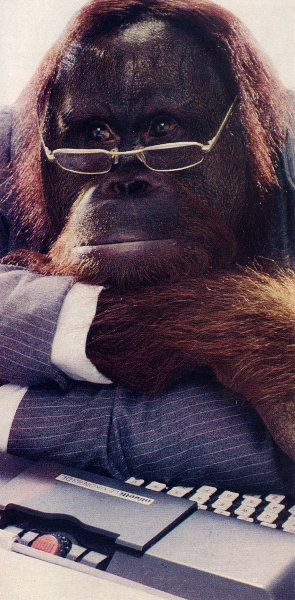
Copyright © TV Guide, 1983 [1]
Now smarter than most humans, the orangutan formerly known as Cha Cha was given the name Mr. Smith and a job with the United States government as a consultant, advising top-level politicians on the most classified of subjects He dressed in suits and wore glasses. Raymond Holyoke starred as Leonard Frey, who was assigned to act as Mr. Smith’s secretary. Tim Dunigan co-starred as Tommy Atwood, who had been Cha Cha’s owner. Laura Jacoby played Ellie, Tommy’s little sister.
You forgot “Manimal”, which aired on the same network in the same season on the same night as “Mr. Smith” and featured a young professor who could change into various animals to fight crime.”
Mark
Rounding out the cast were Terri Garber as Dr. July Tyson, the scientist charged with keeping tabs on Mr. Smith, and Stuart Margolin as her boss, Dr. Klein. Co-creator Ed Weinberger provided the voice of Mr. Smith. “There doesn’t seem to be any middle ground about this show,” said Weinberger. “Many writers were delighted by it. A handful took it almost as a personal insult that such an idea would be tried” [29].
Likewise, critics were split. The Associated Press called it “the best adult comedy” and “best kiddie show” of the new season, suggesting “children will get a kick out of the primate doing his thing, and parents will enjoy his sense of humor and satirical swipes at Washington” [30]. Likewise, Owen McNally of The Hartford Courant also noted the show’s “double-barreled appeal for kids and adults. He called the hour-long premiere “slow-footed and sometimes clumsy” but felt “the show has comic promise and might be funnier and tighter when it runs in its regular half-hour format” [31].
Barbara Holsopple of The Pittsburgh Press, on the other hand, called the series “a dumb idea that does not rise above itself in an equally dumb premiere episode” [32]. Viewers must have agreed with her because the special hour-long premiere on Friday, September 23rd, 1983 averaged a weak 12.1/22 Nielsen rating and ranked 47th out of 57 shows for the week [33].
NBC cancelled Mr. Smith as part of a schedule overhaul in mid-December [34]. A total of 13 episodes were aired, the last of which was broadcast on December 16th.
I Married Dora (ABC, 1987-1988)
Rarely has a television network felt the need to air a disclaimer warning viewers that what they were about to see was illegal. But that’s just what ABC did prior to its special sneak preview of I Married Dora [35]. Why was a disclaimer necessary? Because the series was about a widower who married his housekeeper to prevent her from being deported. That was, and is, against the law, but ABC must have felt the unlawful premise of the series was worth any whispers of impropriety.
Daniel Hugh-Kelly starred as Peter Farrell, the widower, and Elizabet Pena played Dora Calderon, the housekeeper. Dora feared being killed if she was sent back to her home country so when her illegal status was uncovered and Peter offered to marry her so she could stay in the country, Dora agreed. They were both very clear about the fact that the marriage was only for residency purposes, nothing else.
Juliette Lewis and Jason Horst played Kate and Will, Peter’s children. It was Kate’s idea that her father marry Dora in the first place. Henry Jones portrayed Hughes Whitney Lennox, Peter’s boss, and Sanford Jensen played Dolf Menninger, a co-worker. Evelyn Guerrero played Dora’s sister, Marisol.
ABC did not allow critics to screen the premiere of I Married Dora prior to a special sneak preview [36]. The series was given the 8:30-9PM time slot on Fridays, opposite the second half of Beauty and the Beast on CBS and the second half of Rags to Riches on NBC. The sneak preview aired on Tuesday, September 22nd at 9:30PM following Growing Pains and it debuted in its regular time slot three days later on Friday, September 25th.
The sneak preview did quite well, ranking 13th for the week out of 68 shows with a 20.3/33 Nielsen rating. Its time slot debut, however, ranked 61st with a 10.1/18 rating [37]. ABC announced on December 16th that it was pulling I Married Dora from its schedule and would not be continuing production. At the time, the series ranked 63rd for the season, out of 80 shows [38]. The 13th and final episode aired on January 8th, 1988. In the memorable final scene, the cast acknowledged the show’s cancellation and then took one final curtain call in front of the audience.
ABC aired repeats of the series during the summer of 1988.
Cop Rock (CBS, 1990)
Although a number of scripted shows before Cop Rock (among them The Monkees, The Partridge Family, Getting Together, Sugar Time!, Fame, Rags to Riches and Elvis, which premiered seven months before Cop Rock) had regularly featured musical numbers, in most cases the songs were restricted to performances by characters who were singers or in a band. Rare was the television series that attempted to use music in ways not confined to characters who had reason to be singing.
One such show was That’s Life, an hour-long musical comedy starring Robert Morse and E.J. Peaker that attempted to present something along the lines of a Broadway play on television each week. It debuted on ABC in September 1968 and regularly included musical numbers, comedic sketches and dance routines. Although praised by critics for its originality — Jack Gould referred to it as “perhaps the pleasantest, most professional and attractively unpretentious” series of the season — it was cancelled at the end of the season [39].
What sets Cop Rock apart from later attempts to mix music and drama, like Viva Laughlin Eli Stone, Nashville, Glee and Smash, is the fact that it was a police procedural that featured gritty plots ranging from dirty cops to baby-selling, racism to corrupt politicians. This grim atmosphere made for equally grim songs. And there would be five songs per episode. Randy Newman wrote the songs for the pilot plus the show’s theme song.
Steven Bochco, the man responsible for critically-acclaimed dramas Hill Street Blues and L.A. Law, created Cop Rock. According to The Los Angeles Times, which referred to it as “this season’s most outlandish television show,” Cop Rock had been booed when screened for affiliates during the summer [40]. Bochco was undeterred by the negative reaction the series received prior to its debut: “It is a real high-risk venture from a network point of view. It’s not so much a risk for me. If somebody gives you a 10-series commitment and you don’t try something like this, that’s where your risk lies: in getting predictable and doing the same old stuff over and over again” [41].
Many critics were impressed with the series. In his review of the series premiere, Howard Rosenberg of The Los Angeles Times called Cop Rock “fresh, invigorating and one of the true highlights of the new season” [42]. The Washington Post‘s Tom Shales was also positive, ending his review of the premiere by writing “even when the transition from music to drama seems abrupt, or the staging of a number a bit too prosaic, ‘Cop Rock’ has the audaciousness and energy of a true original, plus moments of brilliance that are almost blinding” [43].
In a review published after the series had premiered, John J. O’Connor of The New York Times wrote “in a medium virtually fettered with naturalistic formats, ‘Cop Rock’ may very well turn out to be little more than a passing curiosity. But Mr. Bochco’s risk taking will no doubt continue to be invigorating” [44].
With all the hype, ABC must have had high expectations for the premiere. It drew just 14.3 million viewers and averaged a 10.3/19 Nielsen rating, tying for 56th for the week out of 95 shows. In terms of viewers, it ranked second in its Wednesday 10-11PM time slot, ahead of a Mike Wallace special on CBS. But it ranked third based on ratings [45]. The following week, it fell to 9.5 million viewers and a 7.2/13 rating, tying for 79th out of 92 shows for the week [46].
ABC announced on November 12th that it was cancelling Cop Rock. Said ABC Entertainment President Robert Iger in a statement: “In ‘Cop Rock,’ Steven Bochco delivered a daring and brilliantly produced series, one all of us at ABC are proud to be associated with” [47]. In an attempt to understand why viewers weren’t watching, ABC looked closely at the minute-by-minute Nielsen ratings and learned that many viewers were changing the channel the minute singing began. But Bochco wouldn’t agree to remove any or all of the songs from future episodes [48].
Only 11 of the 13 episodes produced were broadcast by ABC, the last of which was aired on December 25th, 1990. Nominated for five Emmy Awards, Cop Rock brought home two, including one for Randy Newman. In March 1993, A&E Network repeated 10 episodes of the series over the course of a week. VH1 aired all 13 episodes during a marathon on Sunday, July 27th, 1997. Finally, in June 2004, now-defunct cable channel Trio repeated episodes of the series.
Woops! (FOX, 1992)
FOX called this sitcom “an ensemble comedy about the six least likely survivors of a nuclear accident” when it announced its 1992-1993 schedule in May 1992 [49]. At the time, the network scheduled the 10-11PM hour on Sundays and Woops! was given the 10:30-11PM time slot. It would compete with movie nights on the other networks.
The series was set in the aftermath of accidental global nuclear war, started when two boys playing with a toy at a parade accidentally set off a nuclear missile, which soon led to a nuclear apocalypse. In the premiere episode, six people who survived the missiles found their way to a farmhouse that had miraculously survived. It would be a rare example of a science fiction sitcom, a genre not often seen on television (fantasy sitcoms, on the other hand, were quite during during the 1960s and later).
The survivors included Mark (played by Evan Handler), an English teacher who served as narrator; Curtis (played by Lane Davies), a stuffy stock analyst; Alice (played by Meagan Fay), who had owned a feminist book store; Jack (played by Fred Applegate), a homeless man who joked about everything; Frederick (played by Cleavant Derricks), a doctor and also the only African-American survivor; and Suzanne (played by Marita Geraghty), a beautiful but dumb manicurist.
All survived for different reasons. Mark was in his Volvo, which saved him. Jack had been living under an underpass, which kept him alive. Their initial attempts to create a new, perfect society faltered and some were set to go their separate ways when a giant, mutated spider attacked and the six realized they could work and live together.
The show was developed by Touchstone Television for NBC but the network passed after seeing the pilot and Woops! moved to Fox, which ordered 13 episodes. It was reportedly the first time that a show had moved networks during the same development season [50].
Tom Shales of The Wasington Post called the series a cross between Green Acres and Gilligan’s Island, while noting it “isn’t quite as wittily sophisticated as that would imply” [51]. Howard Rosenberg of The Los Angeles Times also made a Gilligan’s Island comparison and argued the series “has satirical possibilities” that weren’t present in the pilot. He criticized the topical humor as “heavy-handed” and called the spider attack the highlight of the episode [52].
The September 27th premiere averaged a 5.0/9 Nielsen rating, a weak fourth in its time slot. It was the fifth lowest-rated program on Fox and overall ranked 94th out of 98 shows [53]. Fox cancelled the series in late November. At the time, it was ranked 105th out of 108 weekly shows [54]. Only 10 of the 13 produced episodes were aired; the last was broadcast on December 6th.
Works Cited:
2 Du Brow, Rick. “Patty Duke Show Rapped by Critic.” Eugene Register-Guard [Eugene, OR]. United Press International. 14 Nov. 1963: 4D.
3 Ibid.
4 “Here’s how national Nielsen’s ranked this year’s shows.” Broadcasting. 4 Nov. 1963: 31.
5 Gould, Jack. “TV: Premieres Galore.” New York Times. 15 Sep. 1965: 94.
6 Review excerpts published in the September 20th, 1965 edition of Broadcasting (“How critics see the new season,” page 34).
7 “A boxscore on the TV week that was.” Broadcasting. 27 Sep. 1965: 70.
8 “First returns in new season.” Broadcasting. 20 Sep. 1965: 32-33.
9 “NBC gets Nielsen nod in 30-market average.” Broadcasting. 27 Sep. 1965: 9.
10 “TV networks look at low-rated shows.” Broadcasting. 18 Oct. 1965: 93.
11 “The Season in Three Parts: How It Turned Out Vs. How Gray Called It.” Television Magazine. March 1966: 40-41.
12 Gowran, Clay. “Bad Series Shows Out–More On Way.” Chicago Tribune. 29 May 1966: G9.
13 Gould, Jack. “TV: Patricia Harty, an Appealing ‘Occasional Wife’.” New York Times. 14 Sep. 1966: 95.
14 Review excerpts published in the September 19th, 1966 edition of Broadcasting (“Critics’ views of hits, misses,” pages 64-65).
15 “The ratings: a photo finish.” Broadcasting. 17 Oct. 1966: 68-69.
16 “Hindsight 66/67.” Television Magazine. Mar. 1967: 28-29.
17 “TV’s Vast Grey Belt.” Television Magazine. Aug. 1967: 54.
18 Review excerpts published in the September 11th, 1967 edition of Broadcasting (“Critics v. new TV season,” page 46).
19 Ibid.
20 Gent, George. “Comedy Series About ‘Defrosted’ Man Opens.” New York Times. 7 Sep. 1967: 69.
21 “CBS, ABC race into season.” Broadcasting. 11 Sep. 1967: 45.
22 “Specials confuse ratings in second week.” Broadcasting. 18 Sep. 1967: 76.
23 “Few of TV’s virgin shows look like hit.” Broadcasting. 25 Sep. 1967: 70.
24 “New shows get no brass rings.” Broadcasting. 2 Oct. 1967: 60.
25 “Four movies in new top-10 list.” Broadcasting. 23 Oct. 1967: 42-43.
26 O’Connor, John J. “TV: ‘Suffer Little Children’ of Northern Ireland.” New York Times. 13 Jan. 1972: 83.
27 “‘Sanford’ holds its own.” Broadcasting. 7 Feb. 1972: 58.
28 “Only two coming on strong.” Broadcasting. 14 Feb. 1972: 28.
29 Anderson, Jon. “Monkeying around.” Boca Raton News. Chicago Tribune. 11 Oct. 1983: 5C.
30 “‘Mr. Smith’ debuts tonight.” Nashua Telegraph. Associated Press. 23 Sep. 1983: 20.
31 McNally, Owen. “2 Promising NBC Entries Debut Tonight.” Hartford Courant. 23 Sep. 1983: F6.
32 Holsopple, Barbara. “‘Mr. Smith’ fails but ‘Love and Honor’ is solid drama.” Pittsburg Press. 23 Sep. 1983: C6.
33 “ABC takes first; ‘Hardcastle’ upsets ’60 Minutes’.” Broadcasting. 3 Oct. 1983: 38.
34 Smith, Sally Bedell. “NBC Revises Prime-Time Schedule.” New York Times. 15 Dec. 1983: C.31.
35 Walker, Joseph. “Updated fairy tale has lots of charm.” Deseret News. 25 Sep. 1987: 8C.
36 Shales, Tom. “What’s New? Fall Television: The Of the People Meter.” Washington Post. 20 Sep. 1987: f01.
37 “NBC on top after first week of season.” Broadcasting. 5 Oct. 1987: 58.
38 Haithman, Diane. “ABC Undertakes Major Overhaul of Schedule.” Los Angeles Times. 17 Dec. 1987: 1.
39 Gould, Jack. “Television: Put Them Together and They Spell Last Year.” New York Times. 13 Oct. 1968: D27.
40 Weinstein, Stee. “Will Singing Cops Be Heard?” Los Angeles Times. 16 Sep. 1990: 7.
41 Ibid.
42 Rosenberg, Howard. “Bochco’s New Beat Television.” Los Angeles Times. 26 Sep. 1990: 1.
43 Shales, Tom. “Cop Rock: Music With a Different Beat.” Washington Post. 26 Sep. 1990: c01.
44 O’Connor, John J. “Scatlogy, Drugs and Rock-and-Roll.” New York Times. 3 0ct. 1990: C18.
4523 Donlon, Brian. “Nielsens: NBC Wins, CBS Still Surprises.” USA Today. 3 Oct. 1990: 03.D.
4624 Sloan, Eugene. “Nielsens: NBC Tops in Ratings, Barely.” USA Today. 10 Oct. 1990: 03.D.
47 Weinstein, Steve. “Bochco’s ‘Experiment’ Over; ABC Cancels ‘Cop Rock’.” Los Angeles Times. 13 Nov. 1990: 2.
48 Ibid.
49 Carmody, John. “The TV Column.” Washington Post. 27 May 1992: c.06.
50 Cerone, Daniel. “How Fox Got Two Sitcoms From ‘the Competition’.” Los Angeles Times. 26 Jun. 1992: 25.
51 Shales, Tom. “TV Previews; Woops! Fox Drops Two Bombs.” Washington Post. 26 Sep. 1992: d01.
52 Rosenberg, Howard. “The Fall Season: Judgment Day Television: Taking the measure of the 35 new series on ABC, CBS, NBC and Fox.” Los Angeles Times. 14 Sep. 1992: 1.
53 “Broadcasting’s Ratings Week: Sep 21-27.” Broadcasting. 5 Oct. 1992: 31.
54 “Fox Broadcasting Bets That Batman Will Fly In Sunday Night Slot.” Wall Street Journal. 25 Nov. 1992.
55 Carmody, John. “The TV Column.” Washington Post. 25 Nov. 1992: e.04.
Image Credits:
Originally Published January 1st, 2004
Last Updated April 21st, 2018


You forgot AUTOMAN, 1983. Best worst show ever.
Automan should have had an origin story, but started with the premise in full swing. I can only recall 1 (one) episode.
Patty Duke Show is great even by today’s standards
Manimal
We loved Woops! We have the first episode on VHS with Herman’s Head!
i’ll buy that vhs from you
I loved the show. All they had to do was compere it to Gilligan’s Island and I was interested. I have all 10 aired episodes which I have put onto DVD for myself. You can find me on my blog Ronn’s Big Pile of Stuff.
Too funny. I remember most of these shows — in particular The Second Hundred Years. My father wrote for it!
The one-liners in “The Trouble with Larry” came fast and furious, but they were all clever. Larry’s different version of logic was the driving force. I have a videotape of the pilot that I still love watching. I was disgusted when the series was cancelled before it even had a chance to catch on via word of mouth; I think it could have been a hit if given the exposure of a better timeslot for its first season. Maybe it just required a more intelligent audience, since many of the one-liners had implied references that I found hilarious. The writers were Andrew Nicchols and Darrell Vickers, Johnny Carson’s head writers
I remember accidentally catching the premiere episode of “The Trouble With Larry.” It was so astonishingly bizarre (all I seem to recall is Larry being tied up on some kind of ship while some large pirate-like woman was trying to seduce him…I think) that for quite a while I wondered if I had really seen such a show or had just dreamed it up. I didn’t know the title, just that it had Pinchot in it, and when I came to this page it was the first show I had in mind. What do you know, here it is! But did I imagine that ship scenario after all??
I loved I married Dora. I would have married her too.
You weren’t the only one
I remember liking The Occasional Wife.
At least “The Second Hundred Years” gave Monte Markham a role that was all his own–two roles, in fact. The rest of his career as a leading man was a case of following in the footsteps of more famous and beloved actors. First there was the film “Guns of the Magnificent Seven,” in which his character was patterned after Steve McQueen’s in the original film (he even wore the same outfit). Then he starred in the series “Mr. Deeds Goes to Town,” in which he had Gary Cooper’s role. He followed that with “The New Adventures of Perry Mason,” in which he took over the role Raymond Burr had played just a few years before. No wonder his career never really took off–viewers were constantly being reminded of actors they liked better.
^Not only that, he ended up playing a friend to Steve Austin (who becomes a bionic man just like Steve only with nuclear powered parts instead of atomic ones, which Steve had) on the Six Million Dollar Man. And also going nuts like Jamie Sommers did-only he wasn’t revived.
I liked “Woops” very much; it aired on Sundays with Herman’s Head. These are two shows I’d love to have on DVD. I had been attempting to look it up, but I had the title wrong; thought it was “Oops”.
You missed Quark.
Quark was an okay show with a sensible comedic idea (a starship that collects garbage, which, if it was revived, would be about a starship of working stiffs employed by a corporation whose job it is to dump waste into black holes or stars); the other shows mentioned here aren’t sensible.
How about “Captain Nice”?
Does anyone else remember the sitcom “Thanks”? It was about the Pilgrims living in New England in the 1600’s. The concept of the sitcom was so utterly strange that I had to watch every episode during its brief run. I think I remember the plot of one episode featured characters getting the Plague!
How about “The Pruitts of Southhampton” with Phyllis Diller? It was pretty bad…
I absolutely LOVED “The Pruitts of Southhampton” for three basic reasons.
Number one…. it came from Filmways, the laugh factory that gave us “Green Acres,” “The Addams Family,” “The Beverly Hillbillies,” “Petticoat Junction,” and “Mister Ed,” shows that still make me laugh out loud……
Number Two….. although filmed at General Service Studios in Hollywood (the first home of Desilu), the backdrop for “Pruitts” was the Biltmore Estate in Asheville, NC (near to where I live).
Number Three is the obvious: Phyllis Diller. Her campiness and tendency to ad-lib around the script was impeccable.
One has to have a sense of humor to laugh out loud at the above shows, all of them parodies of real life. When we have time, we will also discuss the laugh factory that was Screen Gems, located on a back lot of Columbia Pictures and the movie lot “40 Acres.”.
The Pruitts Of Southampton was done better years later as Arrested Development.
Not only that, Diller herself hated the show, and when asked about it on a local radio show here in Toronto, she said ‘Oh, that show….’ which made the interviewer wisely shut up about it.
TV Insider, I totally agree with your reply. Those shows today are still very funny, timeless and non-political without blatant sexual references. Whole family could watch. They stand the test of time!
I liked Pruitts of Southhampton. Phyllis always made me laugh even at 11 years old! John Astin was on the show right after his Adams family run. Bit slap stick but what 11 year old does not like that?? The intro theme was classic too! To each his own, but guess I stand alone. Ahahahahaah! as Phyllis would exclaim.
What about the Secret Diary of Desmond Pfiefer? It was a show on UPN that told the story of the titular character being the butler to Abe Lincoln, who happened to be very similar to a certain president in the 90s when it came to the ladies. This show was absolutely awful.
I remember the promo: A naked woman with heavy armpit hair being dragged across the Oval Office, and Abraham Lincoln looking like a man with a heavy wax mask. It alienated me and caused me to not watch the show.
Does anyone else get the idea that with “Desmond Pfeiffer”, they were trying to create an American “Blackadder” and failed spectacularly?
Pretty much, or at least an American version of Blackadder III.
I watched “Cop Rock” once for the sole reason that I was sure it was going to go down as one of the worst shows and most spectacular failures in TV history, and I wanted to be able to claim that I had seen it. And I was right.
I rather enjoyed ‘Holmes & Yoyo’ when it aired on Saturday nights. It was an inocuous comedy from the same production team that had done ‘Get Smart’ on NBC/CBS a decade earlier.
As I’ve said before on another thread somewhere here, ‘Holmes & YoYo’ must have been based on some ABC concepts research that said viewers wanted to watch shows about robotic humans because ABC skedded a slew of similar-concept series in the 1976-77 season.
For the 1976-77 season, Mr. Silverman skedded a bunch of like-concept series to go with ‘The Six Million Dollar Man’ and ‘The Bionic Woman’, two semi-robot series that were already on the sked. ‘Holmes & YoYo’ were to be funny robots, while ‘Future Cop’ starring Mr. Ernest Borgnine was to be a sci fi drama look at a robotic cop., ‘Future Cop’ had aired its 90-minute backdoor pilot in May 1976 to good ratings, and the limited-order (8-episode) series came on to the air in the spring of 1977 as a “floating” series (“floating” series was a programming concept that Mr. Silverman was experimenting with whereby a series had no fixed time period).
Currently, there’s a series on FOX similar to Holmes & Yoyo, Future Cop, and Mann & Machine-it’s called Almost Human.
Maybe it’s due to the popularity of the concept that the article no longer references Holmes & Yo-Yo. The concept wasn’t even new when it did it, as Yo-Yo was based on Hymie from Get Smart (H&YY was created by one of its producers), and the basic premise was also attempted 13 years earlier with the Julie Newmar sitcom My Living Doll, which itself was remade (by the same producer) a quarter-century later as the infamous Small Wonder.
How about The Charmings?
“Homeboys From Outer Space” is an all time stinker.
Correction; “Homeboys In Oute Space”.
“Homeboys in Outer Space”. Three’s a “charm”. :)
Remember Mr. Merlin?
I do, and there was nothing wrong with that show.
Small Wonder might be seen as a recycling of My Living Doll, by the same producer Howard Leeds. I found this page after searching for opinions about The Second Hundred Years. I just happened to recall that series and wonder how such a show could exist, because it was just an ordinary family show except one member supposedly looked identical to his grandson and had a quaint personality. Also practically every show had at least one episode milking the identical double routine, which amused the audience while reducing the cost of actors, including The Lucy Show, F Troop, Robin Hood, and of course Patty Duke.
I think perhaps it should be pointed out that:
a. Sitcoms originated from family shows about ordinary lives with no gimmickry such as My Three Sons, Leave it to Beaver, Father Knows Best, Petticoat Junction, etc. Put the Real McCoys in Hollywood and you have the Beverly Hillbilly’s. Reverse the migration and you have Green Acres. Put Doby Gillis on a desert island and you have Gilligan’s Island. Perhaps the only “situations” in the situation comedy that were somewhat original and a cut above were those of The Munsters, The Addams Family and All in the Family.
b. While some situation comedies such as I Love Lucy or The Dick Van Dyke show could feature serious comedians, and sometimes be seriously funny, others such as Gilligan’s Island had only a stream of canned laughter and were never funny but just inane. The 60’s and 70’s were a peculiar era before HBO or Netflix. Many people watched inane shows simply because there was nothing better to do.
c. Young people can grow up watching inane shows, just assuming this is the thing to do, then 40 years later suddenly start wondering, why did anyone watch that show?
d. I think we have come full circle and in many ways are worse off with all these vampire soap operas, equally inane and certainly less healthy. I certainly cannot be bothered to watch.
The ‘vampire soap operas’ at least make sense in the context of what universe they’re set with the rules they have. The shows of the ’60’s you mentioned are still crap, any way you slice it.
Similar to ‘Holmes & Yoyo’, there was ‘Future Cop’ with Ernest Borgnine. There was even an astronaut / caveman show in the late 60’s called ‘It’s About Time’ with Imogene Coca.
Small Wonder is definitely the worst i’ve ever seen. Every actor was AWFUL, the boy was squeaky and annoying, and the robot girl… ugh. And same as Michael says in his quote within the article, i couldn’t stop watching.
I was 5 years old in 1977 yet remember my sister and i watched Holmes & Yo-yo. We enjoyed the jokes around the robot guy, and i specifically remember seeing him read a book by fanning the pages, and thinking that was hilarious. Haven’t seen it since, so i have no idea if it’s any good. :/
I recall a Holmes & Yoyo episode where the robot asks his inventor for a childhood, since he was built as an adult and never had one. While working on a childhood memory program, he gave yoyo some toys & childrens’ books to start him off.
The one series I immediately think of belonging to this list is “Salvage 1,” Andy Griffith as a junkman who (among other things) builds a rocket out of junk and goes to the moon.
Salvage-1 was amazing, and deserved a few more seasons.
I recall that episode, sort of like the Wallace & Gromit lunacy of A GRAND DAY OUT. And there’s a computer game called Commander Keen (you have to have very good timing to get by the dog-like alien near the end of one video sub-game).where the kid somehow builds a working spaceship.
‘Me and the Chimp’ averaged 13.3HH in 1971-72, just a decimal above the 13.2HH that ‘Bearcats’ averaged earlier in the season.
Never saw this. I have read that the chimp could not be housebroken and was getting aggressive.
All chimps used as cast, are young. The adults become violent & vicious, and have ~10 times the strength of humans.
After the Travis matter, I don’t think a responsible TV network, Cable or not, will use chimpanzees again.
Travis was a TV star ,but that was when he was a youngster.
Nobody has mentioned “THE SECRET DIARY OF DESMOND PFEIFFER” (UPN, 1998)- about Abraham Lincoln’s butler in the White House, who notes such incidents as Abe having “telegraph sex” with someone supposedly other than his wife- nine episodes were produced; four were shown. One of the unaired episodes has General Grant getting even with Confederate soldiers kidnapping Mary Lincoln by doing the same to General Lee’s wife….UGH!
Beg pardon- “Witecat’ did. Sorry!
There was one series that I do not know the name of. It involved a super-hero who pursued a super-villain out of the comic book world into the real world. Both lose their powers and become normal human beings. I missed the show because when I tuned in to see pt.2, it had already been cancelled. It only had 1 showing.
The other shows I recall are: Turn-On, which was cancelled after just 1 outing. I kept wishing that Rowan & Martin would stroll on & make some order out of this chaos. They never showed up I walked out about 1/2 the way through..
The Last Man on Earth I watched the first episode and part of the 2nd. At halfway through episode 2 I was fed up with it. It was like WOOPS and I wish Fox would STOP trying to lobotomize us.
It was common in the past for failed pilots to air during off-times as single episodes. The superhero show could have been one of those.
The super hero show was called Once a Hero. That one showing had scenes from next time featuring the girlfriend of the hero following him out into the world. The problem was that the cartoonist based the character on his late wife, causing problems for him.
The super-hero series was ONCE A HERO, an ABC show airing on Saturdays at 8:00 (7 Central) in September/October of 1987. Three episodes of seven produced made it to air. A lot of comments here are about short-lived or bad series. The theme of the article being commented on is “outlandish” concepts. Fantasy series are not outlandish just because their concepts are fantastic, a point made more than once in the article. TURN ON was inept, but it wasn’t outlandish.
Hey, most interesting that I’m not the only one who remembers Cop Rock, although my guess would have been that it was broadcast in the late 70s or early 80s. I’m surprised it was broadcast as late as 1990. I remember it so well because it was the weirdest thing I ever saw on TV. I probably only watched one episode, if even a whole episode. I knew it wouldn’t last, and I’ve always wished I’d taped an episode just so I could later review how awful and weird it was. It was much like any police drama, except at various points in the story, the actors would suddenly stop the action and break out in a song about what was happening. Spectacular in its weirdness!
The same joe later did CAPITOL CRITTERS an primetime animated show. Introiduces a family of cartoon mice, gasses them all when they are sitting down to dinner, (like snuffing Mickey,Bianca, Gadget Hackwrench, & so on, in the pilot episodes.) and only one escapes, to live in Washington D.C. The reviewer didn’t care for the graphic dying, and that deterred me from gibvng the show any chance. Oh, and he said the political satire was tepid.
COP ROCK now exists on DVD (as of 2016) to be reexperienced in its perfect awfulness, if that’s your idea of fun.
Bonanza. 4 grown men and a cook Hop Sing .All alone on a ranch.
How did the public accept this obsurd situation.
No women
It was a likely scenario that women won’t be around as much in the Old West, at least at first. It’s not unusual to find a male-only family so a ranch with a father and his four sons was very plausible. Mail-order brides in those times were very common because of the lack of women around.
“Cop Rock” was on ABC.
There’s a couple old specials that were made called The Greatest Shows That You Never Saw and The Best Shows That Never Were. Both can be found on YouTube and should be watched. They list a number of shows with outlandish premises.
Of course the most interesting ones are the ones were the show actually succeeded. Naturally ignoring the comic-book, SF or hard-core fantasy ones like Batman, Star Trek or Game of Thrones which are fictional by their nature. And practically all comic-book premises are outlandish to begin with. (Radiation giving powers instead of just killing people? Costumes?)
Like the one where an astronaut lands on a tropical island (instead of in the ocean) and finds a genie in a bottle.
Or the one with a shaggy alien moving in with a family.
Or any sitcom based in NY were the apartment far exceeds what the inhabitants could possible pay for it.
And you try and talk your whole family into starting a band. Assuming you have a music agent for a neighbor.
Does anyone remember the show that was trying to compete with Dark Shadows? Set on an island. Think it was something about a scientist trying to bring his dead wife back to life.
Thanks
The show was called Strange Paradise, and it was made here in Canada (but sold to the United States.)
I have never understood how Mel Brooks, of all people, could have made a stinker like “When Things Were Rotten”, featuring Dick Gautier as Robin Hood and Misty Rowe (!) as Maid Marian. This show was so absurd that it made most Saturday morning cartoons actually look intelligent! The most intelligent thing ABC did with this show was cancel it midseason and replace it with “The Bionic Woman”.
When Things Were Rotten was a great satire of Robin Hood, and it spawned a similar comedic concept in the UK called Maid Marian, in which Robin Hood is inept (just like Robin Hood in When Things Were Rotten and Maxwell Smart on Get Smart) but not really in charge; Marion is, and she leads the fight against Gisbourne and the Sherrif of Nottingham.
Wow, that’s what I was searching for, what a information! present here at this blog, thanks admin of
this web page.
Here is myy blog Private Instagram-Profile anzeigen
What about a HEIL HONEY, I’M HOME, “sitcom” about the homelife of Adolf Hitler and Eva Braum?
That was a British show, and lasted one episode. All of the series in this article were produced in the U.S. I believe the website founder only writes about U.S. shows.
Re: Mr. smith: You meant to say Leonard Frey starred as Raymond Holyoke, not vice versa.