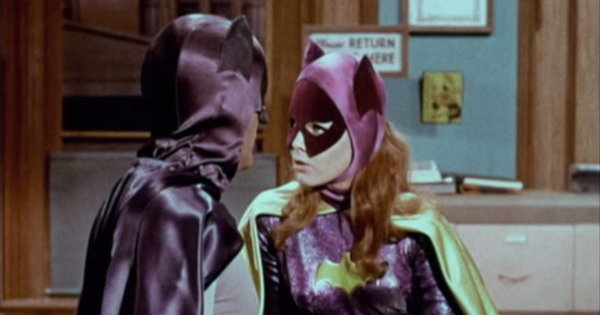
When Batman premiered on ABC in January 1966, the campy sitcom was an instant success. After two seasons, ratings began to fall. To convince network executives a new character was needed, an 8-minute presentation was produced, introducing Yvonne Craig as Batgirl. It was not a pilot for a proposed Batgirl spin-off.
Batman Comes to Television
In September 1965, National Periodical Publications (a precursor to today’s DC Comics) contracted with ABC for a live-action television series based on its Batman character [1]. Although originally scheduled for a fall debut, the new Batman series was soon given not one but two time slots as part of ABC’s mid-season 1966 plans [2]. It would air on Wednesdays and Thursdays from 7:30-8PM beginning January 12th and January 13th, respectively.
Despite the early time slot, Batman was not intended solely for children. Producer William Dozier realized that a heavy emphasis on “exaggerated cliché” could draw adults to the program [3]. And, drawn they were. Early “overnight” ratings from Trendex covering the fifty largest television markets in the country gave the Wednesday premiere a staggering 27.3/49 rating; the Thursday premiere an even more impressive 29.6/59 [4]. ABC easily crushed its competition, the first half of Lost in Space on CBS and the first half of The Virginian on NBC.
Still, such impressive results from a heavily promoted double premiere were hardly unexpected. The real question would come in the following weeks. Would Batman be able to maintain its initial popularity? When Nielsen released its ratings report for the two week period January 10th to January 23rd (which included Batman‘s first four episodes), the Wednesday installment had an average 26.2 rating, ranking 9th, while the Thursday installment averaged a 26.3, ranking 8th. The success of Batman pushed ABC’s weekly rating during primetime for those two weeks to an 18.8, up two points from the previous two weeks [5].
For the week ending February 13th, Thursday’s episode of Batman was at the top of the Nielsen report covering the thirty largest markets, with a 28.5 rating. Wednesday’s episode pulled a 26.5 rating and ranked fifth. Thanks in no small part to Batman, ABC won the week and, more importantly, had increased its share of the audience 10% in just five weeks [6].
When the 1965-1966 season ended, a total of 34 episodes of Batman had been broadcast, twelve on each day. Both installments were in the top ten, with the Thursday installment ranking fifth and the Wednesday installment tenth. Only two other ABC shows, Bewitched and The Lawrence Welk Show, ranked in the top thirty. Whether it was due to the intense promotional campaign ABC waged prior to the show’s premiere or the “camp” factor, the viewing public loved Batman.
Holy Bursting Bubble, Batman
When Batman returned in the fall of 1966 for its second season, ratings had cooled somewhat from the heights of the first season. The show was still scheduled twice a week on Wednesdays and Thursdays from 7:30-8PM. For the two weeks between September 12th and September 25th, 1966, Batman (Wednesday) averaged a 30 share in its two outings, ranking in second in its time slot behind The Virginian on NBC and barely edging Lost in Space on CBS. The Thursday installment averaged a stronger 35 share for its two episodes, winning its time slot, beating Jericho on CBS and Daniel Boone on NBC [7].
Viewers were still interested in Batman, but not in the incredible numbers they had been during the first season when it was the latest fad. That fad quickly passed: imitations introduced in January 1967 on the other networks — Captain Nice on NBC and Mister Terrific on CBS — never caught on. And The Green Hornet, an attempt by ABC and William Dozier to repeat Batman‘s success in the fall of 1966, was less than successful and was canceled after a single season.
A total of 60 episodes of Batman were broadcast during the 1966-1967 season. Neither installment ranked in the top thirty, however. For NBC, Batman‘s slip in the ratings on Wednesdays was a boon for The Virginian, which ranked 11th overall for the season, up from 25th during the 1965-1967 season when Batman was introduced.
Enter Yvonne Craig
Due to the declining ratings of Batman, particularly the Wednesday installment (which when ABC announced its schedule for fall 1967, Batman was only airing on Thursdays [8]. Partially to blame was Lost in Space, which aired opposite the Wednesday installment on CBS. Dozier explained that “they both appeal to the same audience–we estimate that 60 per cent of our viewers are in the 4-to-12 age bracket” [9]. As producer Howie Horwitz aptly put it “we were a victim of our own format” [10].
In an attempt to reinvigorate the show Dozier decided to add a new character for Batman‘s third season. Yvonne Craig would play Commissioner Gordon’s daughter Barbara, a librarian whose alter ego was superheroine Batgirl. Batman was widely watched by young boys and Dozier was of the opinion that a strong female character could bring in an equal number of young girls [11]. Horwitz explained that the character was added to “give the little girls and big boys someone to identify with,” alluding to Craig’s obvious attractiveness, but pointed out that Batgirl wasn’t intended as a love interest for Batman, who was “too square” and didn’t have time for romance; conceivably there could be sparks between Barbara Gordon and Bruce Wayne, however [12].
Yvonne Craig wrote a July 1967 Associated Press article in which she explained how she felt about the character of Batgirl:
And while Batgirl is an active type, she is also very feminine. None of that smacking people low with karate and gung-fu. In my opinion, three karate chops, and you’ve lost your femininity. If a girl goes on a date and a fellow gets fresh, she can’t very well give him a karate chop for a good-night. But if she ducks, she’s simply adept and feminine. Batgirl will be aiding and assisting Batman and Robin, not constantly rescuing then. I like that, too. [13]
Elsewhere, Craig suggested that the reason Honey West (starring Anne Francis as a private detective and broadcast by ABC during the 1965-1966 season) went off the air was that the character “was always going around clobbering somebody, and you can’t look feminine when you’re doing that” [14].
In order to sell ABC executives and/or Batman‘s production company, 20th Century Fox Television, on the idea of adding a new character to the show, a presentation film was put together to showcase Batgirl. In it, Batgirl rescues Batman and Robin from the clutches of the villainous Killer Moth and his henchmen.
The Batgirl Presentation Film
Narrated, like each episode of the series, by William Dozier, the presentation film opens with Barbara Gordon hard at work at the Gotham City Library helping Bruce Wayne prove a point to one of his fellow millionaire playboys. Little does Bruce know that this pretty librarian will soon be saving his life.
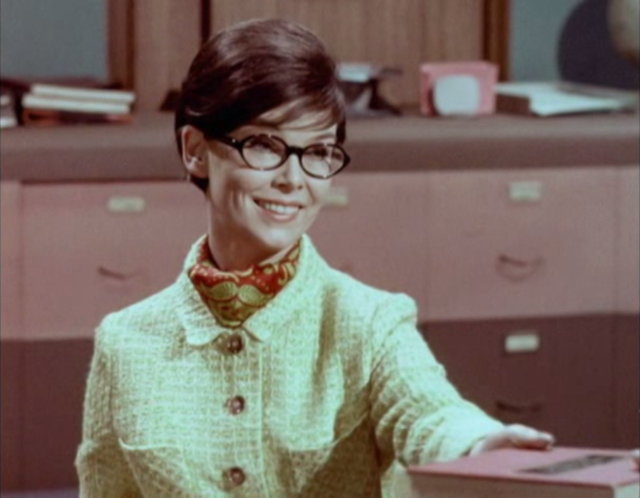
© 1966-1968, 2014 Twentieth Century Fox Film Corporation
Bruce and Barbara chat for a moment and Bruce points out his ward, Dick Grayson, to the librarian before cheerfully saying goodnight. As the two walk out they take note of the four strange men sitting together at a table, all dressed in blue, all wearing metal antennae on their heads. They decide a visit from Batman and Robin might be in order. Shortly after they leave the Killer Moth and his men swing into action, knocking out Bruce’s friend and locking poor Barbara in a lounge. Little do they know that inside the lounge is a secret closet containing her Batgirl outfit.
Suddenly, Batman and Robin arrive and quickly knock out the Killer Moth’s henchmen. But the Killer Moth is ready for the Dynamic Duo and sprays them with his moth spray gun, which results in an instant paralyzing cocoon. Barbara, meanwhile, has transformed into Batgirl, hiding her short black hair beneath a long red wig. She smashes through a window, tangles with the Killer Moth’s henchmen and then frees Batman and Robin with her electronic Batgirl compact/laser beam.
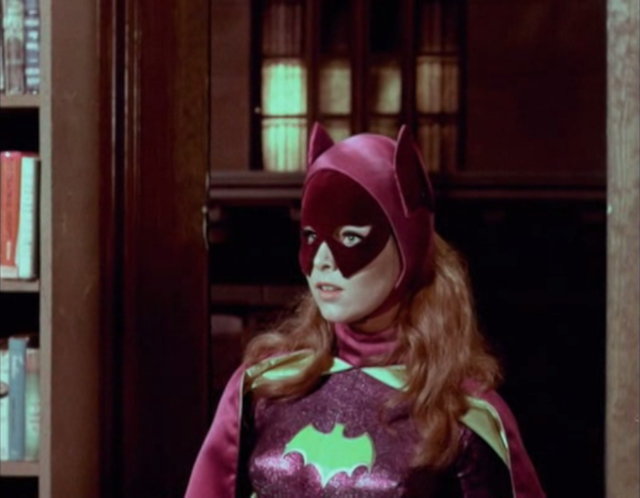
© 1966-1968, 2014 Twentieth Century Fox Film Corporation
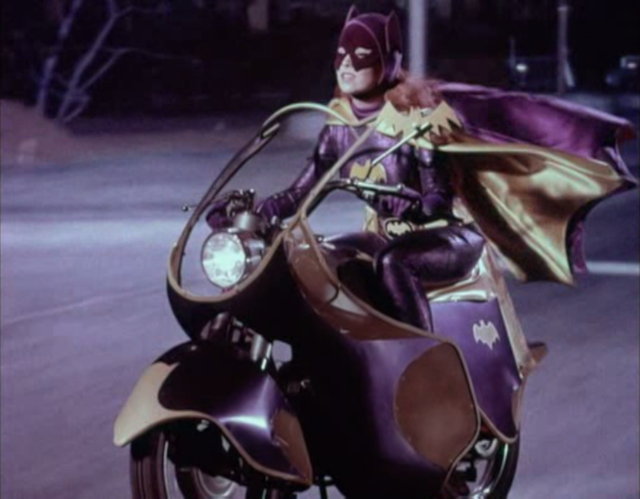
Before long the three have dispatched of the Killer Moth. When Batman asks her identity Batgirl answers that it must remain a secret, just as the identities of Batman and Robin are unknown to her. She then disappears, leaving Batman to ponder aloud whether they’ve just met a new member of their team or a crime-fighting rival. The presentation film ends with Batgirl riding off into the night on her Batgirlcycle.
Analysis
The presentation film lasts just over seven and a half minutes. A revised final draft script dated January 16th, 1967 (titled “Batman: Presentation of Batgirl”) ran 14 pages [15]. The Batgirl costume worn by Yvonne Craig is in the presentation film is slightly different than the costume she would wear during the third season of Batman. The cowl, for example, ties under the chin and the half-mask is pointed beneath the eyes, while the Batman costume features a cowl that tucks over the ears with a half-mask that is rounded beneath the eyes. The presentation film is the only time this variant costume is seen.
The presentation film does an adequate job introducing the characters of Barbara Gordon and Batgirl while allowing the latter to remain something of a mystery. There is no mindless exposition explaining how or why Barbara Gordon decided to put on a cape and cowl and become Batgirl (or how she was able to build a secret closet in the Gotham City Library to keep her Batgirl outfit). That being said, the Killer Moth is without a doubt one of the most pathetic villains of all time. Nothing could be more conspicuous than four men sitting together wearing antennae on their head and yet only Bruce Wayne gave them a moment’s notice.
© 1966-1968, 2014 Twentieth Century Fox Film Corporation
In the presentation film Batgirl is never seen punching anyone. Instead, she uses a rolling globe or a falling bookcase to incapacitate the Killer Moth’s henchmen. She’s allowed to get in a few kicks here and there but nothing more. Of course, the same could be said for April Dancer on The Girl From U.N.C.L.E., who often left the fighting to her male partner, or any of the female security guards on Star Trek, who could kick an alien but never punch them. During the 1960s, it seems, women weren’t allowed to punch because as Yvonne Craig pointed out that wouldn’t be feminine.
Exit Batman
After making the presentation film Yvonne Craig had to wait before learning if Batgirl would be added to the cast of Batman for the 1967-1968 season. She was told the news while at an ABC function in Chicago:
I suddenly realized that I was in the dream situation of every actress who aspires to a television series role. There was no worry about an audience–“Batman” is an established show–and there was no concern about whether it would sell because it’s already sold. As a veteran of four unsold television pilots I can appreciate that kind of security. [16]
Unfortunately, Craig’s first season as Batgirl would be her last. The third season of Batman premiered on Thursday, September 14th, 1967. In January of 1968, William Dozier announced that ABC had informed him they would not be renewing Batman for a fourth season. Although ABC denied they had told Dozier anything, the Nielsen ratings spoke for themselves. Batman had sunk as low as 48th in the weekly ratings, a far cry from its glory days at the top of the charts [17].
On February 13th, 1968, ABC confirmed reports that Batman had been cancelled. The last episode aired Thursday, March 14th and the following week The Second Hundred Years (which had premiered in September of 1967) would take over Batman‘s time slot [18]. The Second Hundred Years was itself canceled in March of 1968 when ABC revealed its new fall schedule; The Ugliest Girl in Town was then given the Thursday at 7:30PM time slot [19].
Availability
Warner Home Video released Batman on DVD and Blu-ray in November 2014. Both the DVD and limited edition Blu-ray complete series sets included the Batgirl presentation film as a bonus feature (Bat Rarities! Straight from The Vault). A second, standard edition complete series Blu-ray set followed in December 2014. It also includes the Batgirl presentation film.
Works Cited:
2 Carlson, Walter. “Advertising: TV Getting Superman in Color.” New York Times. 16 Sep. 1965: 77.
3 Stone, Judy. “Caped Crusader of Camp.” New York Times. 9 Jan. 1966: 75.
4 Gent, George. “Campy ‘Batman’ Flying High on TV.” New York Times. 15 Jan. 1966: 54.
5 Adams, Val. “Antoine to Quit WNBC for WABC After 17 Years.” New York Times. 8 Feb. 1966: 79.
6 Gent, George. “Wife Is Not a Wife in New N.B.C. Show.” New York Times. 19 Feb. 1966: 55.
7 Gould, Jack. “How Does Your Favorite Rate? Maybe Higher Than You Think.” New York Times. 16 Oct. 1966: 129.
8 Gent, George. “A.B.C. Programs For Fall Listed.” New York Times. 3 Apr. 1967: 67.
9 Kleiner, Dick. “Stories in 3 Parts Slated For Batman.” Ocala Star-Banner. 14 Dec. 1966: 28.
10 “Batman In Third Season; Batgirl, New Guests Planned.” Associated Press. Tri-City Herald [Kennewick]. 13 Aug. 1967: 2.
11 Windeler, Robert. “TV’s Top Series Add Ingredients.” New York Times. 21 Jul. 1967: 31.
12 “Batman In Third Season; Batgirl, New Guests Planned.”
13 Craig, Yvonne. “Duo To Become Terrific Trio.” Associated Press. Free Lance-Star [Fredericksburg]. 19 Jul. 1967: 2.
14 Humphrey, Hal. “Debut In Fall: Batgirl On the Way.” Free Lance-Star Town & Country [Fredericksburg]. 13 May 1967: A-19.
15 Until her death in August 2014, Yvonne Craig sold an autographed reproduction of the Batgirl script at her official website.
16 Craig, Yvonne. “Duo To Become Terrific Trio.”
17 “Curses!!! ‘Batman’ Meets His Master: Television’s Ratings.” New York Times. 26 Jan. 1968: 95.
18 “‘Batman’s’ TV Spot Going To ‘Second Hundred Years’.” New York Times. 14 Feb. 1968: 95.
19 Dallos, Robert E. “A.B.C.-TV Plans Replacements For 8 Evening Programs in Fall.” New York Times. 11 Mar. 1968: 83.
Acknowledgements:
Thanks to a good citizen from Gotham for providing high quality screen caps from the Batgirl presentation film.
Batman and all related characters and elements are trademarks of and © DC Comics.
Originally Published June 11th, 2003
Last Updated June 16th, 2018


Batgirl’s “half-mask” was rounded off at the eyes in the series because the original mask left welts in Yvonne’s face, most uncomfortable for her.
And most everyone knows the story that NBC offered to renew “BATMAN” for a fourth season, but their response came too late, as the sets had already been dismantled.
Wasn’t NBC interested in restoring “Batman” to a twice-a-week format?
IF YOU REALL WANT TO GET DOWN TO THE NITTY GRITTY THE BATGIRL/BARBARA GORDON CHARACTER THAT WAS ON TV WAS NOT THE FIRST FEMALE “BAT” CHARACTER SHE WAS IN FACT THE THIRD. THE FIRST WAS BATWOMAN/KATHY KANE WHO FIRST APPEARED IN
Detective Comics #233 (COVER DATED:July 1956).
THE ORIGINAL BAT-GIRL (KATHY KANE’S NIECE-Betty Kane). SHE FIRST APPEARED IN Batman #139 (COVER DATED:April 1961).NOW THE CHARACTER OF BATGIRL/BARBARA GORDON IS THE ONE MOST OF THE GENERAL PUBLIC IS MORE FAMILIAR WITH,BUT SHE DIDN’T APPEAR UNTIL (as Batgirl I): Detective Comics #359 (COVER DATED:January 1967),WHICH WOULD HAVE PUT IT ON NEWSTANDS ABOUT SEPTEMBER 1966 GIVE OR TAKE.NEEDLESS TO SAY IT WAS COMING OUT RIGHT AROUND THE SAME TIME TO CO-INCIDE WITH THE THIRD SEASON PREMIER OF THE SERIES.
THERE HAVE BEEN A FEW OTHER BATGIRL INCARNATIONS OF THE BATGIRL CHARACTER OVER THE YEARS (POST-“CRISIS ON INFINITE EARTHS” (APRIL 1985-MARCH 1986)).FOR MORE INFORMATION CHECK OUT THIS LINK:
http://en.wikipedia.org/wiki/Batgirl.
AS FOR THE KILLER MOTH,WELL HIS CAREER WAS VERY SHORT,First Appearance Was In Batman #63 (COVER DATED:February-March 1951). AFTER THAT HE MADE 2 MORE APPEARANCES (ALSO IN 1951),THREE TOTAL APPEARANCES IN A TOTAL OF 6 MONTHS. THE KILLER MOTH THAT HAD THE RUN IN WITH BATGIRL LATER MADE A DEAL WITH THE DEVIL-NERON AND BECAME AN INSECT LIKE CREATURE NAMED CHARAXES. HIS MOST RECENT APPEARANCE WAS IN Batman #652 COVER DATED:JUNE 2006.
I THINK THAT SHOULD ABOUT COVER IT UNTIL THE KILLER MOTH RRREEETTTUUURRRNNNSSS.
WILD
I think it’s great to see this ‘introduction’ film of Batgirl, but I think the producers screwed up by not using Killer Moth in the 3rd season as a recurring villian instead of using the ones they did especially Lord and Lady Fogg and Dr. Cassandra, those were a waste
Interesting thing about Gary Owens (doing the voice over on the Batman 3rd season preview commercial) at the same time he did that he was the newscaster on The Green Hornet (also on ABC) at the same time he was the announcer on Laugh-In which was on NBC
Why didn’t William Dozier voice that promo?
who said there were no strong female characters in the 60’s. HUH!
Excellent article as always. Except you’re a week late on the series Batfinale; “Minerva, Mayhem And Millionaires” (prod. #1726) aired at 7:30 p.m. (EST) on ABC Thursday, March 14, 1968.
Thanks for the correction. I’ve fixed the error in the article.
Excellent and informative article.I never bew about the Batgirl short.I also look forward to the series on DVD someday.
Up by the picture, “Barbara to Batgirl” I believe it should read, “Once outside, fully transformed, the now titian-haired Batgirl …” Barbara had raven hair. Batgirl had red hair.
NBC offered Dozier a 4th season of Batman but it was too late 20th Century Fox had already dismanted the Bat Cave and Wayne Manor interior sets they were stupid they could have kept them standing as part of the studio tour and they didn’t want to spend the money to re-build them for a 4th season. I think it would have been worth doing NBC should have called Dozier sooner.
I agree! I would have loved another season with Batgirl!!!
It was quite a slip during the 1966-67 season for BATMAN. Nielsen numbers for the season are from Television magazine, Volume 24, Number 8:
WED: BATMAN slipped from 10th to 58th place for this installment, which averaged a 28.6 share. It was dead last in the time slot, with LOST IN SPACE averaging a 30.9 share and finishing 44th, and 10th place THE VIRGINIAN winning the time slot.
THU: BATMAN slipped from 5th place to 36th here, beating the two CBS entries (JERICHO and COLISEUM) but finishing behind 25th place DANIEL BOONE. Still, the show averaged a 33 share here, enough for this installment to be renewed.
Batman was introduced in January 1966, not 1965 as a mid season replacement on ABC aired on Wed and Thurs night with a cliffhanger clearly borrowed from CBS’s Lost in Space. It immediately took a big bite out of The Munsters ratings on Thursday nights (the show did not get renewed for a third season) while only having a minor ratings impact on Lost in Space Wednesday night airings. Batman’s high ratings is said to be the main cause of te “camp craze” on prime time TV. Lost in Space, Voyage to the Bottom of the Sea and even The Man from U.N.C.L.E. shifted away from more serious storylines and into campier waters due to the enormous popularity of Batman. The camp craze was short-lived. Batman’s ratings dropped during its second season and the show was cancelled after its third year on the air.
The cliffhangers on the Batman show were inspired by those in the movie serials. The Lost in Space cliffhangers were really teasers for the next episode.
Also, “Batman” was originally envisioned as a once-a-week one-hour show with the cliffhanger being resolved over a two-minute station break.
Instead, th cliffhanger kept viewers guessing for the next 23-1/2 hours.
The two-=part format of “Batman” was the move that made the show a hit.
I always wondered who would have won between Batman and Cassius Clay.
I remember reading somewhere that the execs on Batman insisted that Batgirl never do any “unfeminine” punching or hitting – only ballet-like moves – like being lifted by the boys so she could kick someone. Ah, well. At least it was progress from the ladies who simply shrieked in a corner while the men did all the fighting.
That whole notion that TV women weren’t feminine if they actively fought men doesn’t seem to be well-informed, even in the sixties. What about Emma Peel in “The Avengers” Not feminine, REALLY! And Agent 99 in “Get Smart” didn’t shy away from punching a guy. In the movies, you had the ultra-feminine Barbara Rhoades dispatching multiple guys & those beach movies featured some beach bunnies punching out guys.
I Love Batman &Robin.
And now, as I post this, we have lost TV’s first superheroine, Yvonne Joyce Craig, a victim of breast cancer at age 78, as of last month. Absent friends… :(
I FINALLY PURCHASED ‘THE BATWOMAN’ , A MOVIE RELEASED IN 1968 AND FILMED IN MEXICO.–WHY WASN’T THERE A TV SERIES FOR BATWOMAN?–I think the movie should be RELEASED(OR RE-RELEASED) AGAIN WITH THE ENGLISH SUBTITLES.–I DIDN’T DISCOVER THE BATWOMAN UNTIL SEPTEMBER OF 2010. THE VIDEO OF THIS MOVIE ON VHS IS NEXT TO IMPOSSIBLE TO FIND.
Also, “Batman” was originally envisioned as a once-a-week one-hour show with the cliffhanger being resolved over a two-minute station break.
Instead, the cliffhanger kept viewers guessing for the next 23-1/2 hours.
The two-part format of “Batman” was the move that made the show a hit.
Batgirl actually made her debut in the January, 1967 issue of Detective Comics (which appeared on newsstands in November of 1966).
I would think that she had been created by Bob Kane to “cash in” on the TV show’s popularity and that the presentation film was made by 20th Century Fox in an attempt to convince ABC to give them the budget necessary to hire Yvonne Craig as a regular cast member so that the TV show would “keep up” with the comic books.