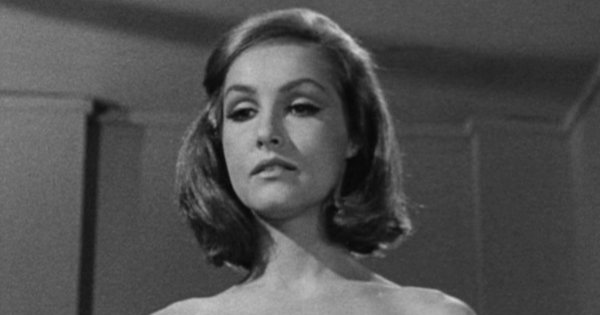
Bob Cummings and Julie Newmar star in this CBS sitcom that ran for 26 episodes during the 1964-1965 season. Newmar played a robot designed to look like a beautiful woman, with Cummings as the hapless psychiatrist stuck looking after her. Halfway through season, Cummings abruptly, and CBS soon cancelled the show. 15 episodes remain missing.
Sitcoms, Sitcoms, Sitcoms
In March 1964, as the television networks finalized their schedules for the 1964-1965 season, comedy was the word of the day. CBS got a big boost when Lucille Ball changed her mind and agreed to continue The Lucy Show for another season after ABC cancelled The Greatest Show on Earth, which was produced by Ball’s Desilu Productions. Without The Greatest Show on Earth, Desilu would have no television programs on the air during the 1964-1965 season and thus Ball decided to keep The Lucy Show in production. [1].
On March 15th, Val Adams reported in The New York Times that there would be a total of 37 half-hour sitcoms on the air during the fall of 1964, with NBC and CBS adding four new comedies and ABC adding five. Among the projected sitcoms on the CBS schedule was The Living Doll, starring Julie Newmar as a robot. Wrote Adams: “Why anyone would want to take a thing of beauty like Miss Newmar and make her mechanical is something only C.B.S. knows” [2].
Not all of those 37 sitcoms mentioned by Adams would eventually make it to the air in September 1964. CBS announced its official 1964-1965 schedule a few days later and The Living Doll had been picked up [3]. It was given the 9-9:30PM time slot opposite NBC’s powerhouse Bonanza and The ABC Sunday Night Movie. Al Martin and Bill Kelsay created the series based on an idea suggested by Leo Guild. It was produced by a Jack Chertok Television, Inc. in association with CBS.
A Psychiatrist And His Robot
On April 20th, The New York Times reported that Robert Cummings had been signed to star opposite Newmar [4]. The Los Angeles Times reported on April 23rd that Jack Mullaney would have a featured role in the series [5]. And on June 21st The Chicago Tribune reported that Doris Dowling would also have a featured role [6]. By this point, the series has been retitled My Living Doll.
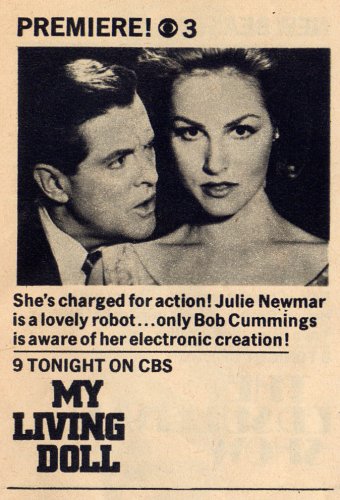
Copyright © TV Guide/Triangle Publications, Inc., 1964 [1]
My Living Doll would be the fourth starring role in a television sitcom for Cummings, who received top billing. His previous shows were My Hero (NBC, 1962-1953), The Bob Cummings Show (CBS/NBC, 1955-1959) and The Bob Cummings Show/The New Bob Cummings Show (CBS, 1961-1962). It was the first regular television role for Newmar, who was officially credited as “The Doll” in the series.
Cummings would play Dr. Robert “Bob” McDonald, a consultant for the Psychiatric Testing Section of Space Research Center, Inc. In the premiere, Dr. Carl Miller (played Henry Beckman) reveals to Bob that Project AF 709 has gone missing from his lab. AF 709 turns out to be a sophisticated robot built to resemble a beautiful woman, played by Newmar.
At first, Bob doesn’t believe Dr. Beckman’s claims that AF 709 is a robot. As proof, Dr. Beckman deactivates her, explaining that the beauty marks on her back serve as control buttons. Furthermore, when a cloth is placed over the robot’s eyes, it enters a state similar to human sleep. Dr. Beckman asks Bob to look after the robot for a few days. Realizing that he can’t let the robot out of his sight, he calls his sister Irene (played by Doris Dowling) and asks her to move in with him temporarily to act as a chaperone.
Mullaney played Dr. Peter Robinson, a physicist at the space center and Bob’s best friend. The two live in the same apartment complex right down the hall from each other. Peter develops an immediate infatuation with Rhoda, much to Bob’s chagrin. Making matters worse, Dr. Beckman is reassigned to Pakistan for several months, meaning Bob will have to watch Rhoda for much longer than he thought. He decides to use the opportunity to study Rhoda and his hypothesis that a robot like Rhoda, were it to develop emotions, would be the perfect woman.
Rhoda, when presented with information she didn’t understand, would utter the phrase “That does not compute” or, if it did make sense, “That does compute.”
Critical Reaction Mixed
Production on My Living Doll began at Desilu’s studios in Culver City, California during the last week of July 1964 [7]. In an interview with Julie Newmar for The Los Angeles Times, Cecil Smith lamented that her character would be a robot, writing that she “is so magnificently assembled a female, so noble a construction (in monumental proportions) that it’s hardly fair she will not be real” [8].
Newmar saw things differently: “But this is Galatea and Bob is Pygmalion. This is the ideal brought to life. Here is a woman very intelligent. A perfect mind, a perfect body. But no emotions. She does not nag, she does not complain. She is never contentious. She is utterly guileless. It is Bob (as a psychiatrist) who must invest her with personality. It’s a part that I think is perfectly espoused — is that the word, espoused? — to my personality” [9].
At the beginning of September, with the start of the new fall season just weeks away, there were mixed reactions to My Living Doll. The Chicago Tribune‘s Francis Caughlin lumped the series with Bewitched, Broadside and Flipper, calling them “the cuties” and arguing they odds against them were long [10]. Cecil Smith, writing for The Los Angeles Times, noted that My Living Doll, Bewitched and The Rogues “are pegged in the trade as major hits of the year” [11].
In his review of the premiere episode, Jack Gould of The New York Times suggested “C.B.S. very probably has the makings of a popular novelty hit; it will take a few more installments to tell” [12]. “With Miss Newmar giving a light and amusing performance as the automated dish,” he continued, “the premise could work out. It will depend on how skillfully the heavenly looking object is introduced to the ways of human existence [13].
Slightly less impressed was Cecil Smith, who called My Living Doll “a fairly amusing show that in a season less cluttered with comedies might be outstanding” [14]. But he praised the cast: “Miss Newmar is gorgeously aloof, Cummings is his usual nimble self, and both Jack Mullaney and Doris Dowling are principals in the proceedings. [15].
The show did have one big fan in the form of comedian Red Skelton: “There are some other shows I like. Bewitched is funny, very funny. And that Living Doll. When I saw that I wanted to build a robot myself but they sold me an Erector set. All I could build was the Eiffel Tower” [16].
Teaching A Robot How To Be A Woman
Episodes of the series revolved primarily around Bob trying to keep Rhoda out of trouble while introducing her to various facets of humanity and society. Rhoda spent the premiere episode wearing nothing but a towel so in the second Bob had to show her how to get dressed without actually showing her anything. He explained stockings, dresses and fumbled his way through an incomplete explanation of garter belts before giving her a fashion magazine and telling her to use her computers to figure out the rest.
With her computing skill and incredible reflexes, Rhoda was able to pick up just about any skill in no time at all. She mastered piano playing after hearing one song. She learned how to type at over 200 words a minute. She was able to calculate where dice will fall and made incredible trick shots while playing pool. When given a stack of more than 250 personnel folders for female employees at the space center, Rhoda was able to compute to a mathematical certainty the perfect date for Peter.
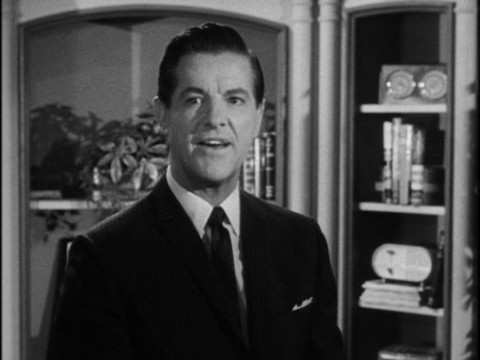
Rhoda even knew how to operate a plane, which helped Peter with his sky diving, but unfortunately she hadn’t learned how to land yet. She had a tendency to repeat things that were said to her, which often led to confusion because people thought she was agreeing with them. And sometimes things went wrong with her circuitry. She was hypnotized in one episode and Bob was forced to deactivate and reactive her. In another, after reading Alice in Wonderland she began suffering from vertigo and Bob had to call Dr. Beckman in Pakistan for help.
Bob was often getting Rhoda out of trouble caused by her misunderstanding something. In one episode, not understanding money or the concept of shopping, she shoplifts expensive jewelry from a store while trying to help Bob pick out a present for Irene’s birthday. The two then have to try to sneak the jewelry back into the store before it is reported missing. He also often found himself in trouble; when he told Rhoda to not let him leave the apartment so he can finish a magazine article, she literally won’t let him leave until the agreed upon time, so he tries to raise the temperature until her circuits can’t take it, leading Irene and Peter to think he’s gone crazy.
Low Ratings Lead To New Day And Time
According to Arbitron, the premiere ranked 43rd (for the period running Wednesday, September 23rd through Tuesday, September 29th) with a 16.9 rating. By comparison, NBC’s Bonanza was second with a 27.0 rating [17]. CBS was satisfied enough with the performance of My Living Doll to renew it for a full season in late October 18].
On December 10th, The New York Times reported that CBS was mulling changes in its schedule. Specifically, the network wanted to give The Beverly Hillbillies a better lead-in [19]. The sitcom, in its third season, had ranked first in the Nielsen ratings during its first two seasons but was faltering. It aired on Wednesdays from 8:30-9PM after low-rated C.B.S. Reports. One option was to move C.B.S. Reports and replace it with something that would give The Beverly Hillbillies a stronger lead-in.
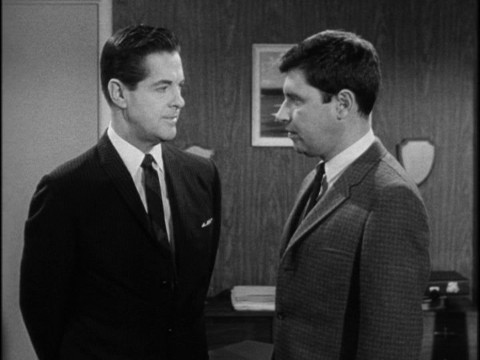
The following day, in what The New York Times called “the most extensive [changes] made by a network in midseason,” CBS adjusted its schedule by canceling two shows (Mr. Broadway and The Reporter) and moving 14 others [20]. C.B.S. Reports was moved to Mondays at 10PM; Mister Ed and My Living Doll replaced it on Wednesdays from 7:30-8:30PM. A new series, For the People, would eventually take over the Sunday 8-9PM time slot.
CBS President James T. Aubrey admitted that the schedule changes were in large part an attempt to help The Beverly Hillbillies: “There is every indication that the very young viewer apparently is controling [sic] the set in the early evening. We have had complaints from parents that they could not watch ‘C.B.S. Reports’ because that’s when their children watched. But putting ‘Mr. Ed’ and ‘My Living Doll’ in the hour at 7:30 we will be building a better lead-in for ‘The Hillbillies.’ We think it will return to the top 10 or the top 15” [21].
My Living Doll had its last Sunday broadcast on December 13th; it moved to Wednesdays beginning December 16th.
Bob Cummings Quits
On January 4th, 1965 CBS announced that Bob Cummings had been released from his contract at his own request after filming 21 episodes of My Living Doll but would not be replaced. The New York Times took that to mean that the network didn’t have much faith in the series [22]. According to Herb Lyons, “Bob Cummings’ decision to quit his faltering My Living Doll TV series didn’t surprise those close. He’d wanted out ever since the first ratings came in” [23]. Larry Wolters echoed that thought, writing that “Cummings is reported to have been unhappy with the role almost since the start” [24].
Wolters would reveal on January 27th that My Living Doll would write Robert Cummings out of the series by sending his character to Pakistan. “You don’t have to believe that, tho. He is withdrawing because he was dissatisfied with the slim role he had as co-star with Julie Newmar” [25]. The final episode with Cummings aired on February 10th. The following week Peter learned the truth about Rhoda and took over as her caretaker.
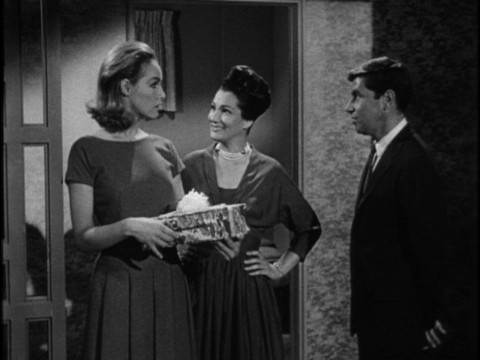
Peter, of course, had no idea Rhoda — who he adored — was a robot but soon adapted to his new role. Doris Dowling and her character were also written out of the series. Replacing her was Nora Marlowe as Mrs. Moffat, housekeeper for Peter and Rhoda. During the final five episodes of the series Peter and Rhoda got into all sorts of trouble. In one episode, Rhoda is asked to travel to Paris for a fashion show, meaning Peter’s girlfriend Ann won’t get the job. In another, her circuits are fried by the sun and she becomes dangerous.
Eddie Foy, Jr. guest starred in the final episode of the season, broadcast March 17th, 1965, as a Mrs. Moffat’s brother, a broken down nightclub performer who wants to revitalize his career by making Rhoda his new partner.
Cancellation
When CBS revealed its 1965-1966 television schedule in early February My Living Doll was nowhere to be found [26]. The schedule would be revised several times before Fall 1965; Lost in Space eventually replaced My Living Doll on Wednesdays. However, in her February 19th column Hedda Hopper reported that Ezra Stone, who directed the bulk of the show’s episodes, had told her the “future of the show depends on reaction to the last five segments without Bob Cummings” [27].
Hopper also revealed that Cummings was planning to sue CBS and that the network wanted John Forsythe to take over should My Living Doll return for a second season. On February 23rd, however, she reported that Forsythe wouldn’t be able to take over for Cummings because his new series (The John Forsythe Show) had been picked up [28]. It didn’t matter anyway. Even if Hopper was correct, My Living Doll wasn’t renewed in the first place, and there was no need to look for a replacement.
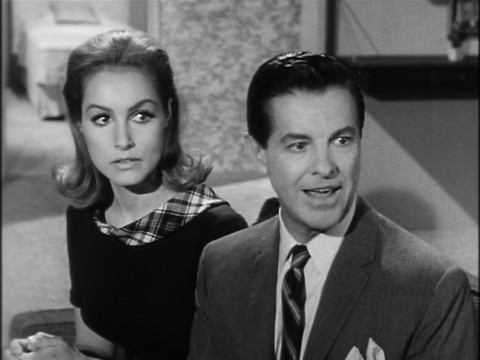
Based solely on November/December Nielsen ratings, My Living Doll ranked 79th out of 96 programs [29]. Whether or not it eventually picked up after moving to Wednesdays or how the last five episodes without Cummings did is unknown. However, if the ratings had improved, it seems likely that CBS would have renewed the series. Repeats were broadcast throughout the summer of 1965; the final repeat aired on September 1st.
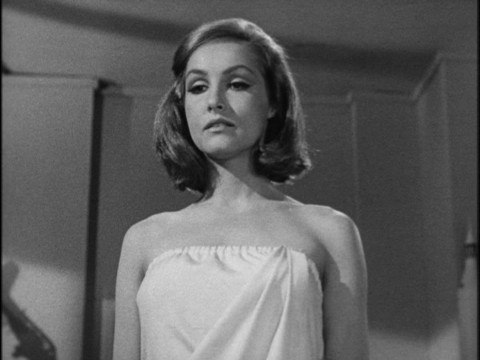
As for the famous sheet Julie Newmar wore in the first episode when she was introduced to Dr. Bob McDonald, it cost $500 and was designed by Elois Jenssen over the course of three weeks with the help of Jane Dutton, seamstress:
Miss Jenssen conducted a careful search for the right weight of raw silk, measured the various lateral dimensions of Miss Newmar, and stitched some two-and-a-half yards of material into an approximate size 12 by exercising artful tuckings, seaming, and hemmings. An elastic rims the strapless bodice and the sheet fastens with strategically placed hooks and eyes. [30]
Said Jenssen of her creation: “Zippers are not flexible enough for the effect we wanted. It looks like a sheet, but it’s made like a gown–it’s designed to look artless, but it really is a very sophisticated garment” [31].
Episode Status
CBS aired repeats of My Living Doll during the summer of 1965. Otherwise, the series never aired again in the United States but did likely air internationally. For years, rumors about the status of the 26 episodes circulated among private collectors. Reportedly only two episodes survived. Or was it six episodes? Maybe it was ten. The rest were supposedly lost or destroyed.
In March 2012, MPI Home Video released 11 episodes of My Living Doll on DVD. None of the final five episodes without Bob Cummings were included.
The fate of the remaining 15 episodes remains a mystery. Are they truly lost forever or will they, too, eventually see the light of day?
Works Cited:
2 Adams, Val. “News of TV-Radio: A Laughing Matter.” New York Times. 15 Mar. 1964: X19.
3 Lowry, Cynthia. “CBS Announces ’64-65 Schedule.” Los Angeles Times. Associated Press. 18 Mar. 1964: D21.
4 Gardner, Paul. “Channel 13 Festival Starts May 1 With a Ballet Film From Sweden.” New York Times. 20 Apr. 1964: 59.
5 “Mullaney Signed for Featured Role.” Los Angeles Times. 23 Apr. 1964: C10.
6 “Radio-TV News Notes.” Chicago Tribune. 21 Jun. 1964: A6.
7 Smith, Cecil. “Julie the Robot: Wind Her Up–Please.” Los Angeles Times. 6 Sep. 1964: O3.
8 Ibid.
9 Ibid.
10 Coughlin, Francis. “Place Your Bets: It’s TV’s Post Time.” Chicago Tribune. 8 Sep. 1964: C8.
11 Smith, Cecil. “Los Angeles Has the Most TV: Fall Network Season Gets Underway Tonight.” Los Angeles Times. 13 Sep. 1964: K3.
12 Gould, Jack. “TV: Networks Cover Warren Report Thoroughly.” New York Times. 28 Sep. 1964: 47.
13 Ibid.
14 Smith, Cecil. “TV Review: ‘Living Doll’ Joins Deadly Funny Season.” Los Angeles Times. 29 Sep. 1964: C14.
15 Ibid.
16 Smith, Cecil. “The TV Scene: Skelton Keeping a Sharp Eye Out.” Los Angeles Times. 12 Oct. 1964: D19.
17 Adams, Val. “C.B.S.-TV Takes Early Lead in Ratings as Close Race Looms.” New York Times. 1 Oct. 1964: 71.
18 Lyon, Herb. “Tower Ticker.” Chicago Tribune. 1 Nov. 1964: 16.
19 Adams, Val. “C.B.S. To Change Hour Of ‘Reports’.” New York Times. 10 Dec. 1964: 95.
20 Adams, Val. “C.B.S. Shuffles Show Schedules.” New York Times. 12 Dec. 1964: 63.
21 Gould, Jack. “Aubrey of C.B.S.-TV Vows Return to Top Rating.” New York Times. 14 Dec. 1964: 71.
22 Adams, Val. “Cummings Quits ‘My Living Doll’.” New York Times. 5 Jan. 1965: 67.
23 Lyon, Herb. “Tower Ticker.” Los Angeles Times. 6 Jan. 1965: 16.
24 Wolters, Larry. “Burgess Meredith to Boss Mr. Novak.” Chicago Tribune. 7 Jan. 1965: D5.
25 Wolters, Larry. “Peyton Place Sets Pace for New Shows.” Chicago Tribune. 27 Jan. 1965: B10.
26 Adams, Val. “C.B.S. Fall Slate Omits 14 Shows.” New York Times. 4 Feb. 1965: 63.
27 Hopper, Hedda. “Beatles, Presley Liked in Liverpool.” Los Angeles Times. 19 Feb. 1965: C13.
38 Hopper, Hedda. “Beatles’ Next Film: A Western Satire.” Los Angeles Times. 23 Feb. 1965: C9.
29 “Hindsight 65/65.” Television Magazine. Mar. 1965: 32-35; 50-57.
30 Mariet, Monique. “Television’s Miss Julie Newmar and the Sophisticated Sheet.” Chicago Tribune. 27 Sep. 1964: N14.
31 Ibid.
Image Credits:
Originally Published May 28th, 2009
Last Updated May 6th, 2018


The series originally had two “alternate” sponsors- American Tobacco’s Pall Mall cigarettes, and Procter & Gamble [they previously co-sponsored the final season of “TWILIGHT ZONE” in 1963-’64]. By mid-season, because of the terrible ratings “MY LIVING DOLL” was getting opposite “BONANZA”, they pulled out, and “participating sponsors” sustained the series on Wednesday nights until the series ended.
Now, you may not know this, but the REAL reason Bob Cummings walked away from the series was because of a script he commissioned from Ray Allen that was supposed to have been filmed as “episode #22”: “Grandpa Visits”, where Bob McDonald’s old codger of a grandfather (yes, virtually the same character he doubled as on “THE BOB CUMMINGS SHOW”, aka “LOVE THAT BOB”) pays a visit…with Rhoda briefly appearing at the beginning and end of the story. When producer Jack Chertok read the script, he was furious. It was bad enough Bob was trying to “teach” Julie Newmar how to act inbetween filming; now, he was trying to ease her out of an entire episode! He and Cummings had a confrontation- Chertok reminded Bob that Julie was his CO-STAR…and that he wasn’t “the” star of the show…and that he had no intention of Cummings turning HIS series into “THE BOB CUMMINGS SHOW”. After a heated argument, Bob walked out of Chertok’s office, off the Desilu backlot…and out of “MY LIVING DOLL” for good.
Confirmation on Mr. Grauman’s insight: the Oct. 29, 1964 Pittsburgh Post-Gazette has an interview with Cummings and article about the series, in which he stated his plans to recreate the “grandfather” characterization for MY LIVING DOLL. “We could always count on a warm response from viewers when my 93 year old grandfather took part in an episode” Cummings was quoted as saying in the interview. Further details about the proposed character indicated he would A) again be from Missouri (Cummings’ home state – Grandpa was from Joplin on LOVE THAT BOB); B) would be piloting a “brand new” 37 horsepower Taylor Cub, and C) would be a Doctor “back home” specializing in general practice and veterinary medicine.
All sounds uncomfortably too close to not only the LOVE THAT BOB characterization, but also easing in the airplane again, which found its way into the second BOB CUMMINGS SHOW (which flopped) as well. No wonder Chertok objected.
…and as for Jim Aubrey’s comments about “CBS REPORTS”, you have to understand that “The Smiling Cobra” didn’t WANT the series on HIS schedule; he felt news and documentaries were a “drain” on the momentum of his entertainment schedule {i.e., we can make more money with our mindless sitcoms and action-adventure/Westerns than waste it on documentaries nobody really watches, anyway}, but CBS chairman Bill Paley reminded him, “news and documentaries are what made CBS what it is today”, and he HAD to keep it on the schedule. He deliberately scheduled “CBS REPORTS” opposite “THE UNTOUCHABLES” on Thursdays in 1961-’62 because he couldn’t find a show to successfully “counterprogram” against it. When he could {“THE ALFRED HITCHCOCK HOUR”}, he moved “CBS REPORTS” to early Wednesday evenings because his combination of “THE ALVIN SHOW” and repeats of “FATHER KNOWS BEST” wasn’t successful against NBC’s ‘WAGON TRAIN” in the 1961-’62 season. “THE VIRGINIAN”, which replaced “WAGON TRAIN” on NBC in the fall of ’62, also got bigger ratings than “CBS REPORTS”- so Aubrey waited until late 1964 to “counterprogram”. He really believed “MISTER ED” and “MY LIVING DOLL” were a better “fit” before “THE BEVERLY HILLBILLIES”, moving “CBS REPORTS” to late Monday nights (opposite ABC’s “BEN CASEY” and NBC’s “ALFRED HITCHCOCK HOUR”), but eliminated all national advertising from the program because the Nielsen ratings service didn’t count “unsponsored” shows in their ratings surveys [Aubrey was under pressure to briing the network’s ratings up after it virtually tied with NBC and ABC that December]. Finally, after Jim Aubrey was fired from CBS in February 1965 {“MY LIVING DOLL” eventually followed him}, “CBS REPORTS” was moved to Tuesday nights that fall, with full sponsorship restored, and stayed there until it ended as a weekly (or bi-weekly) series in 1971.
Incidentally, the footage of the “pilot” shown in the network’s 1964 “fall preview” special was actually from a brief “demonstration film” produced on videotape (later kinescoped) at CBS Television City; see, James T. Aubrey, CBS’ president and chief programmer, was SO enthusiastic about the idea, there wasn’t time for Jack Chertok to produce a “complete” pilot episode in order for the network to “pitch” it to potential sponsors. AFTER it was sold to American Tobacco and Procter & Gamble and scheduled for Sunday nights, Chertok produced an “official” pilot episode on film {“Boy Meets Girl”}.
Thanks as usual, Mr Grauman, fascinating stuff.
I was wondering if a proper pilot had been produced, it would have exposed the poor fit of Cummings in the role (noting mentions in the comments of Larry Hagman or Bob Crane, either of which seems much better). But it appears part of Aubrey’s goal was to put Cummings in a series, in which case I suppose it wouldn’t have mattered.
Anyway, while it’s easy to blame the failure of the Richelieu Productions shows – also infamously bought without pilots (same season, right?) – on Keefe Braselle, this one seems more useful as a cautionary tale about the hazards of flying without a pilot ;)
Ah, censorship….a censor tries to “do the right thing”, and it ultimately makes them look stupid. Would it have been any different if I had mentioned “THE ALFRED HITCHPECKER HOUR”?
Hmmm?
Is anyone ever going to remaster the classic Television Series; “My Living Doll”, I would like to purchase it on DVD’s if it were to be made available. I have heard that someone was considering producing the 26 episodes that exist, but that was some time ago. If you have any information regarding a remastering of the series for commercial sales, please let me know.
Thanks very much,
Sincerely,
Howard Daniel Rollins III
Inventor and Scientist!
My Living doll..will have half of the episodes released on dvd in march 2012
see information on this website or go to amazon.com
http://www.tvshowsondvd.com/releases/Living-Doll-Volume-Release/11969
Bob Cummings was the wrong co-star for the mid-60s “My Living Doll” series with Amazon beauty Julie Newmar. Cummings just had too much baggage from his earlier series “The Bob Cummings Show” and “Love That Bob.” A fresher, newer and younger face such as Larry Hagman, for example, would possibly have helped the show’s ratings. But nothing was going to put a scare into “Doll’s” competition over on NBC’s ponderosa at “Bonanza.”
As a 13-year old kid, I disliked westerns to the nth degree. That’s all I ever saw during the 50’s and was burned out on “cowboy shows.” I remember looking so forward to “My Living Doll” when it premiered, but a month following the show’s debut, I had lost all interest. The novelty of the show was long gone.
I purchased the series DVD this week, and after watching a couple of episodes, I was already searching for another “Amos ‘n’ Andy show to play. “My Living Doll” — in retrospect — was very poorly cast, except for the multi-talented Miss Newmar.
I remember this show pretty well. This show had potential, but it leaked away at the outset with the casting of Bob Cummings, who was able to play only one character throughout his TV career. In this show, his aging lech just made me uncomfortable. I suspect the decision to cast Bob Cummings wasn’t Chertok’s, but Jim Aubrey’s. The comic relief, an actor named Jack Mullaney, was never less than annoying in pretty much everything he did. Julie Newmar was terrific, of course, but here she didn’t have a chance.
Was it true that Cummings visited Dr. Feelgood? Was he hooked as it claims in the book Dr. Feelgood? Was he really on a “God trip” from the methamphetamine he received and could not be reasoned with? It also says Newar was trained at the Actors Studio and that Cummings was still doing the “same old schtick” he did in the fifties with stale responses to Newmar’s acting?
Ms Newmar was just brilliant on My Living Doll. Cummings was just mean. He was screaming at “the Doll” and I found it offensive. She could have held her own on any show on tv and it is a shame that in her prime she never got the chance. She had the comedy of Ms Ball , the beauty of Ms Eden and the grace of Ms Montgomery.
Chertok didn’t want Cummings but he was forced into using him by Paley and CBS. He had wanted to cast Bob Crane for the role, which would have worked so much better.
As for the status of the episodes, it was reported back in the 80s, when Chertok was still alive, that he had chucked out all of his elements after not being able to do anything with the show. While that may seem unlikely, Jack Webb did the same thing with 2 of his failed shows, Noah’s Ark and Pete Kelly’s Blues.
Really, from what source did you confirm Jack Chertok destroyed his failed television series’ elements, as well Jack Webb destroyed “Noah’s Ark” and “Pete Kelly’s Blues?”
As seemingly unbelievable as that may be, it was still the right of Messrs. Chertok and Webb to have done as they wished with their own properties. But I personally think to have done such a thing was tantamount to cultural vandalism. It also showed a lack of respect for all the other talents who worked on those television series’, short-lived though they were.
Hi, I was a purchaser of the MPI Home Video 2012 DVD release of the TV
series My Living Doll starring Julie Newmar and the late Bob Cummings, Volume 1, which consisted of 11 episodes. I am a recent fan of the
show, which I had heard of and read about but never seen until
that particular year. At the beginning of one segment, it was stated
that the program’s owners, Jack Chertok Television, were in search
of the series remaining missing 15 film prints. I am hoping there is
indeed a second volume as has been suggested on certain classic
TV shows and home theater forums as there are people who do
remember this show and watched it originally on CBS and elsewhere
in the last few decades through private collectors.
I would like to know if anyone out there–in particular the specific
representative of Jack Chertok Television whose name I have
seen in such forums (I believe his name is Peter Greenwood)
who has last I heard been searching worldwide for surviving
film prints of the My Living Doll series for subsequent release
on DVD–has any sort of update on locating the aforementioned
remaining prints. Any information would be appreciated.
When there is a second volume and it is eventually released by
MPI Home Video (last I checked they had no information), I
for one would gladly buy it since I have Volume 1 already.
Just letting the powers-that-be know that there is indeed
an audience for this show, if the reviews I have seen from
customers on Amazon who have bought the DVD set
besides me are any indication. By the way, 11 episodes
are better than nothing.
I hope Jack Chertok Television and its present ownership
finds those missing 15 prints. Thanks for listening and I
also hope this post gets the attention of the right people.
Too bad, the 15 episodes remaining are gone for good!
The chances of seeing the last 15 episodes are doubtful. The search still continues.
Bob Cummings made the extremely popular the Love That Bob!
This program was originally titled THE BOB CUMMINGS SHOW. LOVE THAT BOB is the re-titled version for reruns in syndication.
Julie Newmar is very much alive today in California.
Loved this show as a kid, also the Bob Cummings show. Maybe if he had a real robot copy of his first true love, he would have been a perfect individual, but no one has one of those yet (except me) . Bob was the first licensed flight instructor in the U.S., and was an engineer, could appreciate and buy the concept of a humanoid robot. He flew a flying car in the New Bob Cummings show, like Deckard in Blade Runner. (Guess what P.K. Dick was watching in the early/mid sixties.) Julie Newmar was like a spacey beat nick/hippie. The hippies started out with free love, when that didn’t work, they went to true love blues songs. But that didn’t get you anywhere but to a memory, you got high and back in love for a while, but it didn’t get your ex back. The answer was and is, obviously, a freekin’ robot replica of your ex. We’re still waiting for what was so obviously possible in 1964. Pathetic.
Please can someone tell was this the show that bob Cummings had a flying car? This is where he drove to the airport and fitted the tail section and took off. If so can I be sent a video of it? Thanks John
I think that was THE NEW BOB CUMMINGS SHOW.
I found a batch of “My Living Doll” episodes on my on-demand service.
This very clever show was at least ten years ahead of its time. The alleged bad chemistry between Julie Newmar and “Dr, Bob” actually helped- the very concept of a guy teaching a robot to do things is funny in itself. Of course, Ms, Newmar was terrific with her distinct robot-like voice and moves, and Cummings’ ladies-man image was not out of step with the times then. While
“Doll” wasn’t quite the success that Chertok’s other sci-fi sitcom, “My Favorite Martian”, was, it isn’t quaint like so many ’60s shows. And who knew that the word “compute”, foreign to most then, would become universal? If you’re a fan of “Martian”, “The Jetsons”, and this overlooked genre, you’ll love “My Living Doll”!
Loved this. I temember it well.
I purchased what appears to have been a bootlegged copy of the My living Doll TV series, about 10 years ago. It was on VHS Tape format. It featured two episodes; The pilot episode; Boy Meets Girl, and Something Borrowed Something Blew. Unfortunately I no longer have the tape. At one time Something Borrowed Something Blew was on “Youtube”, the episode is no longer there. I hope that the rest of the series will be recovered, I certainly enjoyed watching the show when I was a young boy. I would love to be able to purchase the entire collection. I bought the first release back in 2012, and enjoy it very much. Julie Newmar is an exceptionally great actress, and the show was so well written. It is a shame that it did not have long Gevity. it was certainly a winner in my book. I hope that anyone associated with Jack Chertok Productions will remain relentless in their pursuit to recover the entirety of the series. There are many fans who remember the series, like myself, and others who would enjoy it if it were made complete and available. Take care for now.
Sincerely,
Howard Daniel Rollins III
check out the series availability on Amazon.
Murrah
I remember Isaac Asimov speculating there was a more complete control panel somewhere on “the doll’s” body, but they would never remove enough of her clothing for him to be certain.
My Living Doll did have at least one foriegn broadcast. While I was doing research on the Austrailian TV series Magic Boomerang, I saw that My Living Doll was also being broadcast there. This would have been in the mid 1960s. The newspaper I was looking at had teh episode titles listed many of whihc at the time I did not know.
My original researc on the series showed that only 3 of the 26 episodes had been sent in for copyright purposes. At this point I do not know whihc ones they were. I at one time talked to the company that put the two episodes out on video tape. They were able to do so since the episodes were in public domain, I was told that they had gottne a print of one additional episode but that they could not release it since it was under copyright.
My understanding of copyright law has it that the 23 episodes that were not sent in for copyright are all in public domain so anyone who has copies of them. Meanig at least 8 of the ones on the DVD set have this status.
Hello Alan,
My Living Doll is still in full copyright under US law since all prints do carry a valid (c) notice.
And the DVD release only cements the copyrights once more..
I do have a question for you, in your research you mention it ran on an Australian network ?
Do you know which one as I can try their storage archive for prints as well..have contacted the Australian Nine network so far no luck.
I do not recall the network it was on.
One of the producers of this show was Howard Leeds, who later created SMALL WONDER, which was the same premise except the robot was now a little girl instead of a grown woman. That show also has a connection to BEWITCHED; just as Alice Ghostley replaced Marion Lorne after her death, she joined the cast when Edie McClurg left in the middle of this show’s run. The producers of THE HOGAN FAMILY (née VALERIE) were willing to give McClurg a raise and regular status, which SMALL WONDER’s producers could not afford.
Found this review of My
living Doll because I wondered what happened to the missing episodes. I watched the series as a child and remembered it fondly. Watching it on Netflix this week I was forced to recognize the shows limitations. The biggest problem I see is Bob Cummings. While I like Bob Cummi gs generally he was clearly not well suitec for this role. The second big problem with the show were the scripts. Of course I am viewing the show in 2016 and attitudes towards women have changed a great deal. I found the scripts and dialog very insulting towards women. To the point I could not enjoy parts of some episodes. The sad part was the missed opportunities for exploring the nature of a relationship between a man and a woman. The idea set up by Cumming’s charzcter was to get what a man wanted from a women but not have to listen to her complain. This looked like a flawed premiss they would expose later as the series moved forward, but never did. Julie Numar was the great bright spot of the show. Had to fly with the eagles when you are weighed by a bunch of turkeys.
Just to update this story a bit, I have never stopped looking for the remaining 15 episodes.
They will be found simply because there were too many sets of prints struck for them not to exist.
In 1978 the show ran in full on the closed circuit television system at a military base in Germany.
And further reports have surfaced of it showing at other bases overseas,then a collector claimed to have copies of the last five episodes without Cummings..only to tell me he could not recall where or to whom he sold these prints.
So maybe a collector is sitting on a bunch sadly unaware of the hunt and clear aim to restore and preserve the show for all time.
Just so you know the DVD set released in 2012 is still in the red having not gone into profit after all this time.
But this is not at all about that.
This is a mission for me personally to find and give this show back to all of you who want it.
The show will be found you can bank on it I will not stop until it is. almost ten years searching every day.
Please do look at the special color treated main titles now posted on YouTube to get the show attention once more to aid the worldwide search.
Just discovered this show on Amazon Prime and have enjoyed it immensely. If I can be of any help in searching Canadian archives, please let me know!
Thank you, Peter! I bought the DVD set and while Bob Cummings is the worst part of the show, Newmar is a delight (and the sister character is fun, too; Peter is just annoying).
I have been looking for the “My living Doll” remaining series!! I have only found either 11 or 12 episodes on dvd. If Anyone knows where or how to get them please let me know.
This article and the subsequent comments are just wonderful. Thanks so much. We are watching My Living Doll in summer reruns back in 1965 (we live 55 years ago on https://galacticjourney.org) and while Cummings is unwatchable, Newmar is gold.
This series could be revived as was intended recently, but instead of-let’s face it-the out and out (sexist) comedy shown, it would have to be a comedy-drama about how the gynoid character of said show has to cope with becoming more human while being eventually earmarked for long duration space exploration missions where she won’t be with humans for a very long time. The situations in it can be funny, but funny in an intelligent and non-sexist way.
This is a follow-up for Peter Greenwood:
10 years down the road from your last post, do you have any updates on the situation? If lost 60s episodes of Doctor Who can still be found, surely something more from My Living Doll might still turn up. I’ve got the DVD in the meantime, but I hope you never give up hope in the search.