
In September 1964, Peyton Place debuted on ABC with two episodes airing every week. CBS and NBC began planning their own twice-weekly programs for the 1965-1966 season. Peyton Place expanded to three times a week and Batman earned huge ratings twice a week but by mid-1969 the multi-weekly fad had ended.
Television’s Early Days
In the late 1940s and early 1950s when broadcast television was still young, it was relatively common for some programs to be shown two or three times a week or more. News, of course, was a nightly affair, but so too were many musical/variety shows. For example, between May 1948 and May 1949, CBS aired Face the Music twice a week, three times a week, four times a week, and five times a week. The show had numerous time slots but was most often broadcast from either 7:30-7:45PM or 7:45PM-8PM.
NBC offered Musical Almanac, which also ran 15 minutes, several times a week between May 1948 and April 1949. It may not have had a regular schedule. For many years DuMont broadcast Captain Video and His Video Rangers five days a week (sometimes six times with an additional airing on Saturday). NBC showed Kukla, Fran and Ollie five days a week from 1948 to 1952; ABC would air the series Monday through Friday from 1954 to 1957.
For the most part these programs were only fifteen minutes long and weren’t scripted (Captain Video is one exception). One scripted sitcom that ran more than once a week was Mary Kay and Johnny. From June to August 1949, NBC broadcast the series every night of the week from 7:15-7:30PM. Otherwise, the vast majority of scripted prime time programming was and always has been weekly.
Except for a brief period in the mid-1960s, that is, when ABC sparked a short-lived fad that quickly saw each of the networks offering at least one program (many of them scripted) at least twice a week.
Peyton Place Comes To Television
When ABC announced it would be airing a twice-weekly, half-hour television series based on the best-selling novel Peyton Place, there were two things to be shocked about. First, the content of the novel, written by Grace Metalious and first published in 1956, was filled with sex and violence and many other morally objectionable things. The 1957 movie version was toned down somewhat but the idea of Peyton Place on television was still questionable. So, too, was the idea of Peyton Place airing twice a week, on Tuesdays and Thursdays.
Reporting on the network’s 1964-1965 schedules on January 29th, 1964, Val Adams of The New York Times called Peyton Place a “major innovation” that “might qualify as the first nighttime serial” [1]. Terry Turner of The Los Angeles Times wrote that ABC “will be trying one of the most unusual program maneuvers in years” while revealing that “the proposed television series bears no resemblance to the sordid book that is one of the biggest sellers in recent years” [2].
Turner also gave some indication of how ABC viewed Peyton Place:
More noteworthy, perhaps, is the plan to present two episodes of “Peyton Place” each week. ABC officials insist it can be done without jeopardizing the project.
One immediately wonders what would happen if a viewer chose to watch, say, on Tuesday evening but declined on Thursday. Would he miss anything? Would he be able to then watch the next Tuesday? ABC says Yes–each episode would be a “self-contained unit that, however, leaves the viewer with a desire to see the next show.”
If ABC can pull that one off, it would be the trick of the year. [3]
Although Peyton Place would be the first “nighttime serial” in the United States, Turner pointed out that the most popular television series in the United Kingdom at the time, Coronation Street, aired twice a week on ITV. Would the concept work in the United States? Paul Monash, executive producer of Peyton Place, suggested that serialized television would offer creative freedom: “My interest in serials stems from my growing impatience with the episodic, self-enclosed TV dramas that must rush helter-skelter through a plot to reach a quick and easy climax” [4]. He also suggested that Peyton Place should be viewed as a television novel rather than a prime time soap opera [5].
Peyton Place would also be the first television series in the United States to offer new episodes through the summer repeat season. Said Monash, “we couldn’t do a single rerun even if we wanted to. Each segment bears a direct relationship to the preceding one, and, once it’s aired, it just can’t be replayed” [6]. There was a lot riding on Peyton Place when it premiered in September 1964. It was testing a whole new format for television.
In Instant Success
The first episode of Peyton Place aired on Tuesday, September 15th, 1964. It drew a 27.1 Trendex 26-city rating; the following week, on Tuesday, September 22nd, it beat the season premiere of Petticoat Junction on CBS, 23.9 to 19.1 according to Trendex [7, 8]. The Thursday installment also did quite well, beating the Tuesday episode in Nielsen’s 30-city report for the week ending October 11th, 1964 [9].
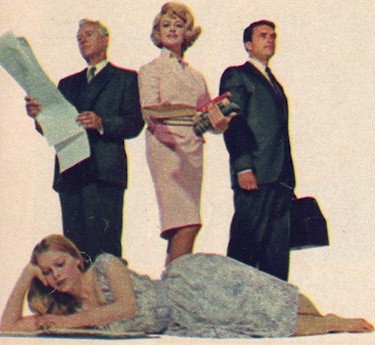
Copyright © TV Guide, 1964 [1]
Peyton Place may not have topped the Nielsen charts but it was nonetheless an instant success with strong ratings for ABC. That led critic Hal Humphrey to worry that the series was television’s Waterloo:
…the current TV season could turn out to be catastrophic for both networks and advertisers, should Peyton Place be the only new series to maintain a high rating in the weeks to come.
By networks’ misinterpreting such a turn of events to mean that viewers crave nighttime soap-opera in twice and three-times weekly dosages, we could wind up next season with mostly old movies and Son of Peyton Place or Return to Peyton Place. [10]
Humphrey was right on the money. In fact, The New York Times had reported in June 1964 — months before Peyton Place premiered — that the show’s executive producer Paul Monash was already “laying plans for another” serial; Warner Brothers, meanwhile, had scriptwriter Paul West working on a proposed serial to be titled Jack and Jill about a newly married couple [11].
Television Magazine reported in its November 1964 issue that production companies were already looking for the next Peyton Place. Screen Gems had two pilots underway, “both designed along Peyton Place lines,” while 20th Century Fox was in talks with ABC to film a “Peytonish” pilot based on The Long, Hot Summer [12]. There was also talk that Peyton Place would expand to three nights each week during the 1965-1966 season [13].
In the meantime, Peyton Place continued to deliver strong ratings for ABC. Jack Gould reported in early December that the network “had spectacular success with its line-up of new programs directed to young families, particularly in ‘Bewitched’ and ‘Peyton Place'” [14]. On December 28th, ABC announced it had renewed Peyton Place for the 1965-1966 season and would be keeping the series on the air throughout the summer with new episodes [15].
Serials Branch Out
As the new year got underway, there were new reports of potential prime time serials. On January 5th, 1965 The Chicago Tribune reported that ABC was planning to premiere The Long, Hot Summer in April and then, should the series prove a hit with viewers, expand it to twice a week in September [16]. On January 20th, Hedda Hopper revealed that NBC was hoping to have Flipper on the air twice a week [17].
In a move that should have surprised absolutely no one, TV Guide reported in its January 23rd issue that ABC was planning a spin-off of Peyton Place to be called The Girl from Peyton Place. It would see the character of Betty Anderson, played by Barbara Parkins, move to New York City and would premiere during the summer of 1965 as a once a week series before moving to twice a week in the fall.
The magazine stressed the new show was still in the embryonic stages. Said William Self of 20th Century-Fox, “all of this is still conversation. ABC has not ordered the show. Irna Phillips is developing a project, but nothing is on paper. In fact, Barbara Parkins has not even been told” [18].
A few days later, Larry Wolters reported that NBC was developing a serial called The Duffield Story about a famous stage actress with a 18-year-old son; Robert J. Shaw was writing the first script. The network also had two other potential serials in the works, one of which would start on Mondays and end on Tuesdays each week [19].
And the rumors just keep flying. According to Herb Lyons, Irna Phillips wanted to take her daytime soap, As the World Turns, to prime time on CBS twice a week [20]. Val Adams passed along word that NBC was considering Dr. Kildare for the twice weekly treatment, to air on Monday and Tuesdays [21].
As the networks began to finalize their 1965-1966 schedules, critics couldn’t help but notice the proliferation of multi-weekly serials. Paul Molloy noted that ABC would have Peyton Place, The Girl from Peyton Place and potentially The Long, Hot Summer all running at least twice a week in the fall of 1965. Said Malloy: “ABC clearly intends to lean strongly on violent human conflicts next season. Whether this is called heavy drama or soap opera, it is obviously catching on in the rating marketplace” [22].
The Girl from Peyton Place was confirmed for ABC’s fall schedule on February 5th by The New York Times, with the network’s vice president of programming revealing that the series would air on Mondays and Fridays from 9:30-10PM [23]. Broadcasting also confirmed The Girl from Peyton Place in its February 8th issue [24]. And on February 16th Herb Lyon updated his earlier report that CBS would bring As the World Turns to prime time; he also stated that NBC would show Dr. Kildare twice a week [25].
Only days later, however, Val Adams revealed that The Girl from Peyton Place had been put on hold; Peyton Place, however, would add a Friday installment in June [26]. And on February 21st he explained that CBS would not be airing As the World Turns in prime time but a twice weekly spin-off. Irna Phillips, who created the soap opera, said that “as far as I know, this is the first time in the history of television and radio that there has been a spin-off of a daytime serial to a nighttime serial” [27].
A Lot of Talk, Not Much Action
Of all the concepts that were floated as possible prime time serials in the wake of Peyton Place, only two actually made it to the air. Dr. Kildare was sliced in half for its fifth and final season, with episodes airing Monday and Tuesday from 8:30-9PM. And CBS did show a spin-off of its daytime soap opera As the World Turns, called Our Private World, twice a week from May to September 1965.
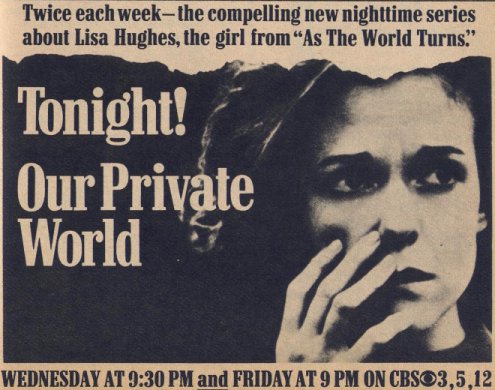
Copyright © TV Guide, 1965 [2]
Our Private World starred Eileen Fulton as Lisa Hughes, a young divorcee transplanted from Oakdale, Illinois (the fictional setting of As the World Turns), to Chicago where she gets a job at a hospital. The series aired on Wednesdays from 9:30-10PM and Fridays from 9-9:30PM. Following its cancellation Fulton would return to As the World Turns. TV Guide‘s Cleveland Amory reviewed the series for its June 26th issue:
Altogether it is the first show we’ve seen in a long time where literally nothing is good — the idea, the producing, the writing or the directing. As for the acting, it has to be seen to be believed — and, believe us, it shouldn’t be. The girls are bad and the boys are worse. One thing this show does, though. It makes Peyton Place look great. In fact, the only thing we cannot fault is the title, Our Private World. The mistake was in making it public. [28]
As for all the other potential serials, the bulk never got past the pilot stage (if they made it that far). ABC’s The Long, Hot Summer ran from 1965-1966 as a weekly drama with first Edmond O’Brien and then Dan O’Herlihy starring, but it was never serialized. And what of The Girl from Peyton Place? There simply wasn’t enough time to put it together according to Herb Lyon [29]. Said Barbara Parkins: “It was supposed to go on in June, but it was scratched because they couldn’t come up with a strong enough storyline. It was a great compliment to me. I was terribly excited. When I found out it wasn’t going to go on, I cried” [30].
The cancellation of Our Private World in early August 1965 led Val Adams to wonder if “industry talk of more nighttime soaps” would soon end [31]. Producer Allen Potter noted that “we were hoping for a runaway rating, but that didn’t happen. However, the show hasn’t been a flop; it has been a success. On Friday evenings the share-of-audience has been higher than that of other shows C.B.S. had in the time period earlier in the year” [32].
And, of course, there was still Peyton Place on the air three times a week. During the 1965-1965 season both the Tuesday and Thursday installments ranked in the Top 20 (Tuesday was 20th, Thursday was 9th). The Friday installment didn’t begin until June 1965, after the regular season had ended.
Nielsen Ratings Take A Hit
When the new television season started in September 1965 there were three programs airing more than once a week: ABC’s Peyton Place on Tuesdays, Thursdays and Fridays, NBC’s Dr. Kildare on Mondays and Tuesdays and ABC’s Shindig, broadcast Thursdays and Saturdays. The musical/variety show premiered as a half-hour on September 16th, 1964 and then expanded to an hour with its January 20th, 1965. On Thursday, September 16th the show began airing twice a week.
When the first two-week Nielsen report was released for the 1965-1966 season (covering the period between Monday, September 13th and Sunday, September 26th), the Thursday installment of Peyton Place was tied for 21st, the Tuesday installment was tied for 35th and the Friday installment was outside the Top 40, as were both installments of Dr. Kildare, while the two installments of Shindig were both in the Bottom 5 [33].
During the summer months, Peyton Place was able to place all three of its installments in the Top Ten [34]. But that was against summer competition. In mid-October, the network released its mid-season plans. The Friday installment of Peyton Place would move to Mondays from 9:30-10PM (switching with The Farmer’s Daughter). The New York Times reported that “some viewers complained that they were usually out on Friday nights and thus missed an episode in the continuing story” of the series [35]. The move took place on Monday, November 1st.
Furthermore, both installments of Shindig were soon cancelled. The Thursday episode would be replaced by Batman, which itself would be airing twice a week. Its second episode replaced The Adventures of Ozzie and Harriet on Wednesdays which, in turn, moved to the time slot formerly held by Saturday’s Shindig. These changes would take place in January 1966.
As the 1965-1966 season wore on, Peyton Place continued to sink in the ratings. For the two weeks ending November 21st, only one of its three installments made the Top 40; the Tuesday installment tied for 40th with My Favorite Martian [36]. As for NBC’s Dr. Kildare, in November 1965 The New York Times reported that it would likely be cancelled at the end of the season due to low ratings (in the most recent Nielsen report, the Monday installment had ranked 72nd out of 102 programs and the Tuesday installment 58th) [37].
Enter Batman, Exit Everything
Thankfully for ABC, even as Peyton Place was losing its luster, a new twice weekly program burst onto the scene. Batman was even more of an immediate success than Peyton Place. It aired twice a week on Wednesdays and Thursdays and both installments were in the Top 10 for the two-week period ending January 23rd [38]. The first two Thursday episodes averaged a 26.3 Nielsen rating and ranked eighth while the first two Wednesday episodes averaged a 26.2 rating and ranked ninth. When the 1965-1966 season ended, the Thursday Batman was 5th and the Wednesday Batman 10th.
Peyton Place, however, couldn’t even crack the Top 30. Based on the Nielsen ratings from October to December 1965 the Tuesday/Thursday installments of Peyton Place tied for 43rd out of 99 programs. The Friday (later Monday) installment was 58th. As for Dr. Kildare, its Monday installment tied for 67th and its Tuesday installment tied for 61st. Shindig did even worse: its Thursday installment was 92nd and while its Saturday installment was 93rd [39].
Dr. Kildare went off the air in August 1966, leaving ABC the only network with programs airing more than once a week. For the 1966-1967 season, Peyton Place was cut back to two broadcasts each week, first on Monday and Wednesday and then on Monday and Tuesday. Batman continued on Wednesday and Thursday evenings. The following season, Batman was cut back to one episode a week. Peyton Place ran the entire 1967-1968 season airing on Monday and Thursday.
Batman was last broadcast on Thursday, March 14th, 1968. It aired a total of 120 episodes. Peyton Place continued for one final season, once again on Monday and Wednesday evenings. In February 1969, however, even Peyton Place was cut down to one episode a week, Monday from 9-9:30PM. Its final episode — its 514th — was broadcast on Monday, June 2nd, 1969.
The series that in September 1964 sparked the fad of airing a television series two or more times a week had outlived all others. But it was a shell of its former glory. For the two weeks ending February 9h, 1969, Peyton Place ranked 98th out of 116 programs [40].
Works Cited:
2 Turner, Terry. “Dark Horse? ABC Will Try Night Soap Opera.” Los Angeles Times. 6 Feb. 1964: C11.
3 Ibid.
4 Bart, Peter. “Will TV Serials Find Success? Tune in Again Next Fall for…” New York Times. 26 Jun. 1964: 61.
5 Ibid.
6 “You Won’t See This Series Next Summer!” Chicago Tribune. 25 Jul. 1964: A19.
7 “Fall shows are off and running.” Broadcasting. 21 Sep. 1964: 96.
8 Adams, Val. “2 TV Towns Begin Race for Ratings.” New York Times. 24 Sep. 1964: 83.
9 Smith, Cecil. “The TV Scene: Nielsen Deals–Read ‘Em and Weep.” Los Angeles Times. 21 Oct. 1964: D18.
10 Humphrey, Hal. “Soap Opera Trend: Peyton Place May Be TV Waterloo.” Los Angeles Times. 9 Oct. 1964: C18.
11 Bart, Peter. “Will TV Serials Find Success? Tune in Again Next Fall for…”
12 “The Month in Focus.” Television Magazine. Nov. 1964: 7-8.
13 Ibid.
14 Gould, Jack. “New Nielsen Study Finds TV Networks In Three-Way Tie.” New York Times. 7 Dec. 1964: 1.
15 Adams, Val. “Sponsors Stay On In ‘Peyton Place’.” New York Times. 29 Dec. 1964: 39.
16 Coughlin, Francis. “New Trend on TV Is Spelled S-E-X.” Chicago Tribune. 5 Jan. 1965: A10.
17 Hopper, Hedda. “Looking at Hollywood.” Chicago Tribune. 21 Jan. 1965: C12.
18 “For the Record.” TV Guide. 23 Jan. 1965: A-1.
19 Wolters, Larry. “Peyton Place Sets Pace for New Shows.” Chicago Tribune. 27 Jan. 1965: B10.
20 Lyon, Herb. “Tower Ticker.” Chicago Tribune. 3 Feb. 1965: 18.
21 Adams, Val. “Telsun Puts Off Three U.N. Shows.” New York Times. 11 Feb. 1965: 79.
22 Molloy, Paul. “The TV Scene: ABC Out to Hold No. 1 Rating Spot.” Los Angeles Times. 4 Feb. 1965: C12.
23 Adams, Val. “A.B.C. Plans New Show on ‘Peyton Place’ Theme.” New York Times. 5 Feb. 1965: 63.
24 “Tackling the ’65-66 jigsaw puzzle.” Broadcasting. 8 Feb. 1965: 64-65.
25 Lyon, Herb. “Tower Ticker.” Chicago Tribune. 16 Feb. 1965: 23.
26 Adams, Val. “Suds for All Seasons.” New York Times. 21 Feb. 1965: X15.
27 Ibid.
28 Amory, Cleveland. “Review: Our Private World.” TV Guide. 26 Jun. 1965: 1.
29 Lyon, Herb. “Tower Ticker.” Chicago Tribune. Feb 19. 1965: 18.
30 Stern, Herald. “Love and Hisses Bring Her Stardom in Peyton Place.” Chicago Tribune. 8 May 1965: B3.
31 Adams, Val. “C.B.S. Soap Opera Is Going Off TV.” New York Times. 3 Aug. 1965: 63.
32 Ibid.
33 “TV networks look at low-rated shows.” Broadcasting. 18 Oct. 1965: 93.
34 Larry Wolters reported on August 27th, 1965 that “Peyton Place occupies three of the top 10 positions–third, sixth and seventh–in the current Nielsen ratings” (“Our Private World Flops as Soap Opera,” The Chicago Tribune, Page B18).
35 Gent, George. “A.B.C., 3d in Ratings, to Revise Schedule of Evening Programs.” New York Times. 16 Oct. 1965: 55.
36 “It’s CBS by a nose.” Broadcasting. 13 Dec. 1965: 76.
37 Adams, Val. “TV Doctor Shows Expected to End.” New York Times. 19 Nov. 1965: 79.
38 “NBC leads latest Nielsen report.” Broadcasting. 14 Feb. 1966: 83-84.
39 “The Season in Three Parts: How It Turned Out Vs. How Gray Called It.” Television Magazine. Mar. 1966: 40-41.
40 Gowran, Clay. “TV Today: Expect High Mortality in ABC Shows.” Chicago Tribune. 27 Feb. 1969: S13.
Image Credits:
2 From TV Guide, Eastern New England Edition, May 1st, 1965, Page A-57.
Originally Published June 11th, 2009
Last Updated May 6th, 2018


Great feature!
Specially, when NBC is going to be happy when Leno take in 10-11 P. M. (ET) weekdays in September!!! Could we see a comeback in a concept in the making?
During “The Golden Age Of Radio”, “THE LONE RANGER” was broadcast three nights a week- Mondays, Wednesdays and Fridays at 7:30pm(et)- LIVE (from WXYZ, Detroit), from 1934 through 1954…first over Mutual, then on NBC-Blue, which became the “Blue Network” (after NBC was forced to divest itself of that outlet, by government decree, in 1943, keeping their “Red” network in the bargain), changing its name to ABC in 1945. There were other examples of multiple evening radio series [for instance, Glenn Miller and his band was on for Chesterfield with his 15 minute “MOONLIGHT SERENADE” on CBS three nights a week at 10pm(et) from 1939 through ’42, moving to 7:15pm in the spring of ’42 before leaving the show that September to enter the service; Coca-Cola was on SIX nights a week during the war in prime-time {“every night except Sunday”, at 9:30pm(et)} over Mutual with their “SPOTLIGHT BANDS” remotes from defense plants and military outposts, featuring all of the “big name” bands appearing at one time or another…].
Procter & Gamble was the “primary sponsor” and produced “OUR PRIVATE WORLD”, treating it as though it were just an extension of their daytime soap, “AS THE WORLD TURNS”, on videotape, very quickly (this is why Cleveland Amory wasn’t impressed, as he really didn’t watch “soap operas”). And there was the fact that the series wasn’t on the same time on Wednesdays and Fridays, as “PEYTON PLACE” was. It followed “THE DICK VAN DYKE SHOW” at 9:30 on Wednesdays, which was probably the highest rated of the two weekly episodes….but “OUR PRIVATE WORLD” followed “THE CARA WILLIAMS SHOW” at 9pm on Fridays, a series that didn’t do well on Wednesdays after “VAN DYKE”, and was cancelled, along with “WORLD”, at the end of the season. Eileen Fulton returned to “AS THE WORLD TURNS”, and continues to appear as “Lisa” to this day.
“DR. KILDARE” went to a half-hour format in the fall of ’65 (and telecast in color for the first time), featuring semi-serialized stories that lasted as brief as two episodes and as long as six [“BEN CASEY” dabbled in some “ongoing” storylines as well].
And then of course, ABC filled prime-time with THREE evenings of “THE DICK CAVETT SHOW”, after his ground-breaking 1968-’69 daytime talk show was cancelled by the network, during the spring and summer of 1969 at 10pm(et) before moving him to late night that December, replacing Joey Bishop. So Jay Leno isn’t the first talk show host in prime-time….
Barry, Let’s not forget the revived version of YOURS TRULY, JOHNNY DOLLAR from October 1955 to December 1956 with Bob Bailey.
It was on CBS Monday-Friday 8:00-8:15pm.
Bailey who was considered the best DOLLAR stayed with the show until 1960
“Batman” aired twice a week because ABC had only open half-hour slots in early-evening.
Supposedly, the show had been envisioned as a one-hour, once-a-week show, with the cliffhanger resolved over a station break.
But since only half-hour slots were open at 7:30 P.M. (Eastern time), the cliffhanger that would have been resolved after a station break wouldn’t be until the next night.
That was the move that made “Batman” a big hit.
All thorough 1966, people all over America from schoolchildren at recess to housewives in backyards to executives in boardrooms discussed how Batman and Robin would get out of this week’s dilemma.
We all knew they would; what we wanted to know was how.
In the 1967-68 season, the show was cut back to once a week, and I think that move killed the show. “Batman” wouldn’t have been a long-term hit, but if it stayed on the air twice a week, I think it might have lasted four seasons, maybe into a fifth.
The promo included here was filmed for the 1966-67 fall season of “Batman” and featured some new Bat-gadgets (most of which were introduced in the 1966 “Batman” movie, were acquired under the movie’s budget) that were used periodically during Seasons Two and Three of the TV series.
The Invaders and The Legend of Jesse James were going to be this way, but when ABC picked up these two shows, The Invaders aired for one hour and The Legend of Jesse James has a single half hour installment instead of two.