• Recent Posts

  • Recent Videos

  • Recent Comments

  • Tags

  • Site Archives

  • Main Content

    Archive for July 2009


    Historical TV Schedules

    W2XBS Schedule, Week of May 19th, 1940

    Here’s the schedule for NBC’s experimental station W2XBS in New York City for the week beginning Sunday, May 19th, 1940. I don't know why there were no broadcasts on Sunday or Monday. Maybe there weren't any films to show. It also seems to me like there were more films shown this week than usual. Only two sporting events, a wrestling match and a race, plus a variety show, a sketch show and a drama.

    Read the rest of this entry »
    Historical TV Schedules

    W2XBS Schedule, Week of May 14th, 1939

    Here's a spotty schedule for NBC’s experimental station W2XBS in New York City for the week beginning Sunday, May 14th, 1939. On Thursday, May 18th, 1939 The New York Times began including television broadcasts at the bottom of its daily radio listings so daily broadcasts for the end of the week are known. On Wednesday, May 17th W2XBS broadcast the very first baseball game from Baker Field using two mobile television trucks. An article published in The New York Times the following day stated that the game ran for 2 hours and 15 minutes and began with an introduction of coaches and team captains by announcer Bill Stern [1].

    Due to the sun shining directly into the camera for the first few innings everything was described as dark. Later, however, "the diamond became clear and the skyline of apartment buildings sharply defined in the background" [2]. Here's an excerpt from the article that explains some of the shortcomings of the broadcast:

    The players were best described by observers as appearing "like white fliers" running across the screen. It was impossible for the single camera to include both the pitcher's box and home plate at the same time. The "eye" was focused on the mound for the wind-up and quickly followed the ball to the batter and catcher. Seldom were more than three players visible on the screen at one time, and until the picture was clarified after the fourth inning the outfielders were "forgotten men." [3]

    Stern was said to have "saved the day" with his play-by-play commentary. And for the record, Columbia's Ken Pill hit television's first home run. Viewers were able to see him rounding the bases [4]. Following the baseball game was coverage of a bicycle race from Madison Square Gardens [5]. A fifteen-minute program titled "Premiere of Plumage Fashions," a brief re-eneactman of a fashion show that took place ta the Ritz-Carlton the previous day was also said to have been broadcast on Wednesday evening [6].

    Presumably the rest of the week stuck more or less to the schedule of films and studio presentations W2XBS had introduced two weeks earlier, with a film block from 11AM-4PM on Monday, Tuesday and Friday. On Thursday, films were shown from 4-8PM and studio presentations from 8-9PM. That likely would have been Wednesday's schedule if not for the baseball game. Saturday saw more films and additional coverage of the bicycle race. I can't say whether anything was broadcast on Sunday, May 14th.

    Sunday, May 14th, 1939
    Off the air?

    Monday, May 15th, 1939
    11:00AM-4:00PM – Films.

    Tuesday, May 16th, 1939
    11:00AM-4:00PM – Films.

    Wednesday, May 17th, 1939
    4:00-8:15PM - Baseball, Princeton vs. Columbia at Baker Field.
    8:30-9:00PM - Six-Day Bicycle Race, at Madison Square Garden.

    Thursday, May 18th, 1939 [7]
    11:00AM - 4:00PM - Films.

    Friday, May 19th, 1939 [8]
    4:00-8:00PM - Films.
    8:00-9:00PM - Studio Variety Show.

    Saturday, May 20th, 1939 [9]
    4:00-8:00PM - Films.
    8:30-9:00PM - Six-Day Bicycle Race, at Madison Square Garden.

    Works Cited:

    1 "Televised Baseball Due First Time Wednesday." New York Times. 15 May 1939: 17.
    2 "First Television of Baseball Seen." New York Times 18 May 1939: 29.
    3 Ibid.
    4 Ibid.
    5 A May 17th, 1939 article in The New York Times about the baseball game mentions that "the first telecast from Madison Square Gardens will be made at 8:30 P.M., when scenes of the six-day bicycle race will be picked up" ("Television Game Today," Page 19).
    6 "To Televise Fashion Show." New York Times. 16 May 1939: 45.
    7 "Today on the Radio." New York Times. 18 May 1939: 37.
    8 "Today on the Radio." New York Times. 19 May 1939: 35.
    9 "Today on the Radio." New York Times. 20 May 1939: 25.
    Bookshelf

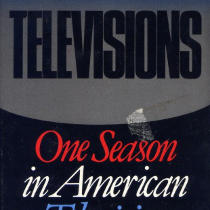
    Bookshelf: Televisions: One Season in American Television

    Televisions: One Season in American Television
    By Marc Eliot
    Published in 1983
    Published by St. Martin's Press
    179 Pages

    I picked up a copy of this book at a used bookstore several years ago. Sadly, that bookstore has since closed. But I still have my hardcover copy of Marc Eliot's Televisions: One Season in American Television, published in 1983. It's a fascinating analysis of the 1981-1982 television season in the United States of America which involves a strike, the coming of cable, Jerry Falwell's Moral Majority and more. Eliot focuses heavily on Nielsen ratings, which are always interesting, and also interviews producer Garry Marshall.

    In his prologue, Eliot explains that every so often a television season comes long that is defined by a single program. Or, perhaps, by a newsworthy real-world event. Of the 1981-1982 season, Eliot writes that it was "dominated by off-screen, unscheduled events and issues--political, social, economic." He explains that politically, the season was defined by strikes; socially, it was the Moral Majority; and economically it was the expansion of cable.

    Eliot devotes two chapters to the Moral Majority, four to ratings, one to cable, one to drugs, one to independent production and two to miscellaneous items. He introduces the Moral Majority and the Coalition of Better Television with its boycotts of programs unsuitable for children due to violence or sexual content. M*A*S*H, The White Shadow, Flo and Soap were among the shows criticized for vulgar language while Happy Days, Too Close for Comfort and Three's Company were some of the shows that were too sexual.

    Televisions: One Season in American Television
    Televisions: One Season in American Television - Copyright 1983 St. Martin's Press

    A proposed boycott never came to fruition but sponsors pulled out nonetheless. Eliot also discusses Ed Asner's political inclinations and his involvement in the 1981 writers strike, plus the cancellation of Lou Grant. There's a chapter on television news and a few pages on daytime talk shows. But by far my favorite part of the book are the chapters analyzing Nielsen ratings. He briefly introduces the ratings, then talks about the November sweeps period (proving the complete ratings for the week ending Sunday, November 8th).

    Perhaps the most intriguing portion of the book involves a comparison between the first half of the 1981-1982 season with the 1980-1981 season. Dallas, for example, was down from a 31.8 Nielsen rating to a 28.1 rating. The Dukes of Hazzard fell from a 25.2 to a 21.8, The Love Boat from a 24.1 to a 21.0 and House Calls from a 22.3 to a 19.5. On the other hand, 60 Minutes grew from a 26.8 rating during the 1980-1981 season to a 27.6 rating during the first half of the 1981-1982 season.

    Televisions: One Season in American Television
    Televisions: One Season in American Television - Copyright 1983 St. Martin's Press

    Finally, Eliot provides the complete rankings for the 1981-1982 season as a whole. NBC's Fitz and Bones was dead last at 105th with a 8.7 rating. ABC's Police Squad was 57th with a 15.5 rating. NBC's Q.E.D. tied for 98th with a 10.1 rating. He discusses how the networks were disturbed by the way teenagers were drifting away from broadcast television (that sounds familiar, doesn't it).

    The interview with Garry Marshall covers all manner of topics: the Moral Majority, censorship, ratings, strikes, quality, cable, time slots, older viewers and more. Another interview, with a group of network executives who wished to remain nameless, discusses the cost of a pilot, the Moral Majority, whether or not Hill Street Blues can succeed, how much authority writers have and the trend of making television shows out of movies.

    All told, Televisions: One Season in American Television is a great read. I only wish Eliot had continued writing such books for later seasons or, better yet, earlier ones. It's out of print but you should be able to find a used copy online.

    Reviews

    DVD Review: Mr. Terrific - The Complete Series

    I've long wanted to review DVD releases of rare, obscure and short-lived television shows. I have a bunch I'd like to review if I had the time but I just haven't gotten around to it. Today's guest review covers the July 17th, 2009 release of Mr. Terrific in Germany and comes courtesy of Rob Falcone, perhaps the biggest fan of Mr. Terrific in the world (or at least the United States; the series has quite the following in Germany). He's also an expert on the series. You can order the DVD set from Amazon.de but be warned that you'll need a DVD player capable of reading Region 2 encoded discs. A region-free player should work fine but I can't make any guarantees.

    "Immer, wenn er Pillen nahm – Die komplette Serie"
    ("Mr. Terrific – The Complete Series")

    by Rob Falcone

    When you come right down to it, the long awaited DVD release of the obscure 1967 sitcom “Mr. Terrific” is a pretty bare-bones kind of deal. Remember that the principal target audience for this particular set is fans who live in Germany. Such fans, having actually been exposed to syndicated broadcasts of the series within the last decade, might well be disappointed in the dearth of extras presented here. These are limited chiefly to the original, English language option and several pages of text, in German, presenting information about the show.

    There is no footage included that would be considered “new” to a German audience. The original, unsold 1966 pilot starring Alan Young is absent; as is the subsequent 1968 compilation film, “The Pill Caper.”

    But American fans, and those in other countries, may find this release quite remarkable for two reasons. Number 1 is the fact that it exists at all, the series having been given up for lost in the country of its origin. Number 2 is the aforementioned English language option which gives the viewer a chance to hear the voices of the actual actors who brought these characters to life.

    Episode Run Times

    Listed in the order in which they appear in the new DVD release. The numbers in parentheses denote each episode's position in the original, 1967 broadcast sequence:

    Matchless (edited) (1) 24:10
    Harley and the Killer (10) 24:11
    My Partner the Jewel Thief (4) 24:07
    Mr. Big Curtsies Out (2) 23:57
    Has Mr. Terrific Sold Out? (12) 24:09
    Stanley the Safecracker (6) 24:14
    Stanley the Jailbreaker* (8) 23:53
    The Formula Is Stolen (5) 24:10
    The Sultan Has Five Wives (17) 24:05
    Fly, Ballerina, Fly** (9) 23:59
    Stanley Joins the Circus (16) 23:34
    Stanley Goes to the Dentist (13) 24:07
    I Can't Fly (3) 24:15
    Try This on for Spies (15) 24:07
    Stanley and the Mountaineers (11) 24:12
    Stanley the Fighter (7) 24:14
    Stanley the Track Star (14) 24:11

    *There is an abrupt cut leading into the climactic scene of "Stanley the Jailbreaker." It looks like there might be a little something missing. I've seen a couple of different prints from German TV distribution, and they all have the same problem.

    **There's an awkward cut almost halfway through "Fly, Ballerina, Fly." Apparently one of guest star Cynthia Lynn's lines was dropped, but this might have been the case even in the 1967 aired print.

    For those who are unfamiliar with “Mr. Terrific,” it is the story of Stanley Beamish (played by Stephen Strimpell): a sweet, underdeveloped gas station owner who happens to be the only person capable of deriving super strength and flying ability from a government supplied “power pill.” Stanley’s best friend, partner and roommate Hal Walters (Dick Gautier) is a mildly egocentric ladies man who knows nothing of Stanley’s alter ego. The two government agents who give Stanley his pills and send him on assignments are Barton J. Reed (John McGiver) and Harley Trent (Paul Smith).

    “Mr. Terrific” has hardly been seen, and apparently not been syndicated at all, in the United States since it first aired in 1967: a CBS mid-season replacement that produced only 17 episodes in its January to August run. Fans, mostly folks who were kids in ’67, had to wonder if there was any chance of seeing this little gem again. Now, thanks to a devoted German fan base, our prayers have been answered. Here are all 17 episodes; nice sharp prints, and all in English as well as German dubs.

    That having been said, and as wonderful as the set is for fans of the show, there are certainly some problems with the release.

    In the first place, the episodes are not in the original, 1967 broadcast sequence. A friend in Germany checked out some websites and found that the episodes are presented in the order in which they were first run in Germany beginning in 1970. Actually, only the first 13 of these episodes aired in Germany in 1970. The last four didn’t show up there until 1992.

    Now for a series as episodic as “Mr. Terrific,” the sequence of installments is generally not that vital. But purists and continuity buffs may be irked by the contradictions that exist here. The second episode in the set “Harley and the Killer” makes reference to events that took place in the fourth episode “Mr. Big Curtsies Out.” And the early placement of “Killer” contradicts a line of dialogue (concerning whether or not Stanley has ever flown with passengers) in the tenth episode “Fly, Ballerina, Fly.” The next-to-last episode “Stanley the Fighter” introduces George (Bonnie Hughes), an assistant attendant at Hal and Stanley’s Service Station. But George has already appeared in two episodes in the set as well as in the establishing shot for a third.

    The first episode in this set, and the first aired in 1967, is “Matchless.” This appears to be the only episode in this collection that’s edited. It begins with the regular, illustrated opening but with no introductory segment, and the traditional narration spoken by Paul Frees has been wiped from the soundtrack. Since this “aired pilot,” as it is often called, contains relatively little exposition, it’s odd that Frees’ narration should be removed from this one segment. The rest of the episode plays out very much like the edited print that ran here on TVLand a few years back. So perennial drunk Hal Smith is relegated to an extra, and his two exchanges with Strimpell are excised, as is the scene where foreign agent Shenko (Harold J. Stone) dispatches one of the good guys. The second half of this episode is more inclusive, and less choppy, than the TVLand print but still not quite complete.

    I clocked “Matchless,” and it comes in at 24 minutes and 10 seconds. I also clocked the last four episodes, and they all hover around the same length. Perhaps they included an edited print in this one instance to maintain some sort of uniformity of length.

    There are also occasional, mostly minor, problems with synchronization. I imagine this isn’t too uncommon for some of these older shows, and I don’t believe it is unique to this particular release of the series. The sound seems to be slightly ahead of the action pretty much throughout the episode “Stanley the Jailbreaker.” I first noticed the same problem while watching a print of “Jailbreaker” that was taped off German television years ago. Other instances, notably a really striking problem confined to the introductory segment of “Stanley Joins the Circus,” may not have been quite so visible in the poor quality prints that had previously emerged.

    The German episode titles, which are clearly viewable on the disc menu, are also briefly super-imposed on the screen after the credits role. In addition, these prints all seem to be missing one, quick, cartoonish image of a noble steed that originally appeared in the show’s illustrated opening. These, of course, are minor issues.

    Generally speaking, despite a few problems that might irk some fans, these are nice, clean prints of all 17 episodes, neatly reproduced in a two disc collection. The menus are clear and easy to navigate, even for people who can’t read German.

    The package art is appealing, although the depiction of the “power pills” looks more like evidence in a drug bust than anything you’re likely to see on “Mr. Terrific.” One photo that appears on the back of the box, a shot of our hero racing with a jetliner, was particularly noteworthy to Stephen Strimpell. According to him, the still was never actually used to promote the show. He also maintained that it was not he, but his good friend and stunt double Chuck Courtney, that appeared in the picture. This was one of the few mementos of “Mr. Terrific” he retained and cherished.

    In a letter I received from Strimpell just about two months before his death in 2006, he told me that he was “not one to dwell on things past.” I respect his sentiment. I cannot totally agree with it.

    I’m not alone in cherishing the culture I grew up in. Many people in my age group have a great fondness for, and even a longing to revisit, the fleeting, televised images of our youth. For me, “Mr. Terrific” has been one of the most important and elusive of these images.

    Thank Heaven, in an age in which every manic cackle that escapes Spongebob’s porous lips has been preserved on home video for ages to come, somebody remembered a slight, young man with tousled hair who flapped his arms, so he could fly. Thank Heaven Mr. Terrific is back.

    DVD Tuesday

    DVD Tuesday: The Donna Reed Show, The Judy Garland Show

    It was originally supposed to come out last week but for some reason was delayed. Barring further delays, today you can pick up The Donna Reed Show: The Complete Second Season, containing all 38 episodes from the 1959-1960 season. The show ran for a total of eight seasons on ABC and at the rate of one season a year you'll be able to complete your collection of The Donna Reed Show by 2016. Unless, of course, multiple seasons are released in one year. Anything's possible.

    Also out today is The Judy Garland Show, Volume One. The variety show, which ran from 1963 to 1964 on CBS, produced a total of 26 episodes. Between 1999 and 2003 or so, Pioneer Entertainment released the entire series on DVD in a smattering of volumes and in two large boxed sets. All of these are now out of print.

    The DVD out today from Infinity Resources contains the first two episodes of The Judy Garland Show; an additional twelve volumes will cover the remaining 24 episodes. The episodes have been remastered and included as extras are some outtakes. I believe Pioneer remastered their releases as well so it might be interesting to see a comparison. The only footage from the show that I've seen came from appeared to be a grainy, multi-generation VHS dub several years ago. Anything would be an improvement from that.

    Finally, Alpha Video is releasing three new public domain titles today, including The Adventures of Sir Lancelot, Vol. 4 and Golden Age of Television, Vol. 8: Kelly/The Machine Calls It Murder, which contains episodes of Kraft Television Theatre and Sunday Mystery Hour.

    Content Copyright (©) 2003-2013 TVObscurities.com. Copying from this site is strictly prohibited. No ownership of television shows intended or implied.
    About | Site Map | FAQ | Press | Disclaimers