• Recent Posts

  • Recent Videos

  • Recent Comments

  • Tags

  • Site Archives

  • Main Content

    Archive for September 2009


    Bookshelf

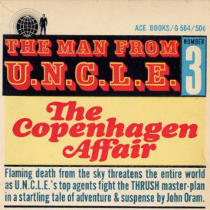
    Bookshelf: The Man from U.N.C.L.E. #3, "The Copenhagen Affair"

    The Man from U.N.C.L.E. #3 - "The Copenhagen Affair"
    By John Oram
    First Published in 1965
    Published by Ace Books
    144 Pages

    The Man from U.N.C.L.E. had one of the most successful tie-in lines of all time, with 23 novels published between 1965 and 1968 by Ace Books. A 24th novel was written by never published (read about it here). Sixteen of these novels were also published in the United Kingdom with different covers and a different numbering system. I have seven of these novels, the last being #11. Many of the latter novels are quite hard to find these days. Amazon.com has copies of #23 with prices as high as $207.06 (it might actually be cheaper to buy the U.K. version).

    What struck me the most about "The Copenhagen Affair" was the level of violence. Certainly, The Man from U.N.C.L.E. was a violent show, with plenty of gun play and fist fights, but it wasn't necessarily bloody, especially during the rather campy third season. This novel, though, is quite explicit. Illya Kuryakin shoots one particularly evil women between the eyes. Earlier, several bad guys are killed during a gun battle:

    It certainly was not a scene of domestic bliss. Rabbit Face was sprawling near the door with half his head shot away. Eiler, center stage, grinned vacantly at the shattered ceiling with a blue hole between his eyes. A huddle of duffel coat in a pool of blood represented all that was left of the saturnine Bjorn.

    The novel isn't all blood and guts, though. The THRUSH threat of the week is a flying saucer of sorts, one that is very, very dangerous but one that also doesn't have all the kinks ironed out. The prototypes have to be blown up in mid-air rather than crash to Earth. Napoleon Solo is sent to Denmark to track down a man named Garbridge who is in charge of the saucer program.

    The Copenhagen Affair Front
    The Copenhagen Affair Front - Copyright 1965 Ace Books

    Solo gets himself captured by Garbridge and his thugs but manages to escape and soon meets up with Illya. The two join forces with another U.N.C.L.E. agent, a red-head named Karen, and some former Danish resistance fighters from World War II who can be trusted. They find Garbridge's underground plant and plan to destroy it. They're able to knock out most of the T.H.R.U.S.H. agents/scientists inside but Garbridge gets away with Karen.

    Karen is brought to a maternity home that doubles as a T.H.R.U.S.H. facility where she meets a vile women named Ingrid who worked as an interrogator during World War II. She has a room full of nasty whips and chains and hooks and electrical devices. Karen faints. Thankfully, before Ingrid can spend too much time with Karen, Solo and Napoleon arrive to rescue her. But Garbridge gets away again.

    The Copenhagen Affair Back
    The Copenhagen Affair Back - Copyright 1965 Ace Books

    The two track Garbridge back to his facility where he jumps in his saucer and tries to fly away. Instead, he crashes and dies in a giant explosion. Karen recovers sufficiently to join Napoleon and Illya for dinner.

    On TV

    Gunsmoke, Rawhide and Have Gun, Will Travel Coming to Encore Westerns in 2010

    Premium cable channel Encore Westerns will begin airing Gunsmoke in January of 2010 according to The Hollywood Reporter. The show has previously aired on Encore Westerns but hasn't been seen in four years. Rawhide and Have Gun, Will Travel, also from CBS TV Distribution, will debut sometime in 2010. Encore Westerns is one of seven Encore channels owned by Starz Entertainment, it seems, none of which I have ever seen.

    The article quotes Nancy Silverstone, vice president of program acquisitions for Starz Entertainment as saying "our Westerns viewers are made up of true and diehard fans of the genre. They were devastated when 'Gunsmoke' went off the channel four long years ago. The series is still relevant today as it was over 50 years ago. We have no doubt that our fans will also be excited by the addition of the classic series 'Have Gun Will Travel' and 'Rawhide.'"

    Television History

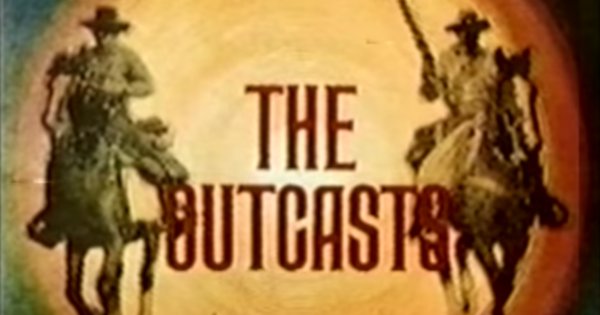
    TV & Violence in 1968: The Outcasts

    I wrote briefly about ABC's The Outcasts in yesterday's Q & A but today I thought I'd focus on how the network changed the show following the assassination of Senator Robert Kennedy on June 5th, 1968. Within days of Kennedy's death, several congressmen called on the television network's to shift focus away from violence and crime in their programs. President Johnson formed the National Commission on the Causes and Prevention of Violence, chaired by Dr. Milton H. Eisenhower, to examine how violence influenced society.

    The networks -- and the television industry as a whole -- reacted by announcing new policies on violence. Summer repeats involving violent content were pulled while scripts for new and returning fall shows were rewritten. Over the next few days I'll be discussing how various shows were impacted by the increased scrutiny of violence.

    Recall that The Outcasts starred Don Murray as Earl Corey and Otis Young as Jemal David -- a former slaveholder and a former slave, respectively -- who become bounty hunters following the end of the Civil War. That certainly sounds like the basis for a violent program. Bounty hunting, at least as depicted on television, is a rough and tumble lifestyle. And as a western, The Outcasts would be expected to contain its fair share of shoot-outs and bar fights.

    In the September 23rd, 1968 edition of Broadcasting, ABC President Elton Rule revealed that the network (with the cooperation of production company Screen Gems) had decided to rewrite parts of the first ten scripts and re-shoot portions of the six completed episodes of The Outcasts because of content that "might be considered excessive violence in today's new climate" [1].

    I don't know if that means ten additional scripts after the first six episodes were rewritten or if the scripts for the six completed episodes were drastically -- and completely -- rewritten. In any event, according to Rule the changes made to the series "cost dearly," although he doesn't explain whether he meant it cost a lot of money or if it was creatively painful [2].

    Interestingly, in a June 10th, 1968 article in The Los Angeles Times Don Murray was said to be a critic of violence on television; he even occasionally went more than a year without working because he wouldn't take on a role that "glorified violence" [3]. But Murray didn't think much of the way the television industry was "indulging" in "soul-cleansing" following RFK's assassination:

    It's tokenism they're practicing. There's no difference between good and bad violence, I happen to think the violence on TV and in movies is destructive, but that must be proven scientifically. Then laws should be passed, just as there's a law against selling or possessing heroin. If this is censorship, then let it be. I think the League of American Theaters and the three networks should set up rules on violence anyway. [4]

    As for The Outcasts, Murray explained that it "may be contributing to the violence on TV, but I believe this is offset by [the] white-Negro relationship" and he revealed that so far he had only felt one scene was too violent and that scene was "fixed" (presumably rewritten to be less violent) [5].

    In his review of the premiere, Clay Gowran noted that "'Outcasts was one of the series partially reshot to exclude unnecessary violence. What is left in the first episode is a fight sequence [short, with background music that is light and gay], deaths of the two bad guys [from a distance without blood], and one shooting ["He only grazed me."]" [6]. Other reviews made no mention of violence.

    The Outcasts was cancelled after its first season. A September 25th, 1969 article in The Los Angeles Times about violence on television stated that "shows like ABC's Outcasts and NBC's Outsider, which depended heavily on violence, were scrapped" [7]. However, I think it is far more likely that ABC cancelled the series mostly due to low ratings, with the issue of violence little more than an afterthought.

    So what happened to the footage from those first six completed episodes that was excised? Was it thrown out? Probably. Why would the production company save it? Would could it possibly be used for? If The Outcasts were to be released on DVD (which is unlikely) the unused footage would make for an interesting special feature. But in 1968, it would have been all but useless. Unless, of course, someone thought it could be inserted back into the episodes for foreign syndication.

    UCLA's Film & Television Archive has a copy of the premiere episode and notes that it may have "been reworked and reshot for a subsequent episode, The long ride, broadcast on Apr. 28, 1969." As luck would have it, The Museum of Broadcast Communications has that episode in its collection and the guest casts are totally different. Furthermore, television listings in The Los Angeles Times state that the April 28th, 1969 episode involved Earl and Jemal capturing a man who killed an Apache woman; the pilot episode, on the other hand, saw the two seeking a criminal helping to protect a shipment of gold.

    Those are the only two episodes held at the four big television archives. Many others circulate among private collectors. If the series was syndicated internationally, it would be interesting to compare copies of those episodes with copies presumably from the United States.

    Works Cited:

    1 "Rule asserts ABC's reaction to violence." Broadcasting. 23 Sep. 1968: 50-52.
    2 Ibid.
    3 Humphrey, Hal. "Protests Made Him an Outcast." Los Angeles Times. 10 Jul. 1968: E18.
    4 Ibid.
    5 Ibid.
    6 Gowran, Clay. "TV Today: Andy Leaves Series; Lucy's Kids Join Show." Chicago Tribune. 24 Sep. 1968: B19.
    7 "TV Adds to Violence but Is Improving, Commission Says." Los Angeles Times. 25 Sep. 1969: 1.

    DVD Tuesday

    DVD Tuesday: The Patty Duke Show, Various Fan Favorites

    Out today is Shout! Factory's The Patty Duke Show: Season One, featuring all 36 black-and-white episodes from the 1963-1964 season. Bonus features include new interviews with Patty Duke, William Schallert and others (they may be part of a featurette, I'm not quite sure). The ABC sitcom ran for three seasons and 104 episodes, plus an unaired pilot episode with a somewhat different cast. That unaired pilot isn't included in the Season One release. It was, however, edited into the season finale as a flashback.

    Also being released today are a dozen "fan favorite" single-disc sets from Sony Pictures, each of which contains six or seven episodes apparently taken from one season. Shows getting the "fan favorite" treatment include All in the Family, Bewitched, I Dream of Jeannie, Good Times, Sanford and Son, The Jeffersons, Diff'rent Strokes and Barney Miller (plus some more recent shows). Exactly why these are being released is a mystery. Does Sony think people who don't have any of the season sets of these shows are going to purchase a "fan favorite" disc and then suddenly want to buy all those season sets?

    Finally, Alpha Video has three new releases today: The Adventures of Ozzie & Harriet, Volume 15, The Adventures of Robin Hood, Volume 20 along with a six-DVD set collecting The Adventures of Ozzie & Harriet, Volumes 6-11 (5-DVD).

    Q & A

    Q & A: The Outcasts, What Really Happened to the Class of '65?

    I get a lot of e-mails from people asking me about television shows, made-for-TV movies or miniseries they remember from years or decades past. I try to answer each question as best I can. Every now and then I like to dig through my inbox and pull out a few choice e-mails to answer here at Television Obscurities for everyone to read. Keep reading for today's questions and answers.

    I am trying to find a show that was a WESTERN called "The Outcast." I don't remember who else starred in it but I know one of the stars was Otis Young.

    Thank You
    -Lisa

    Otis Young was indeed one of the stars of ABC's The Outcasts, along with Don Murray. The series was set after the Civil War and followed the adventures of a Virginia plantation owner, and former slaveholder, Earl Corey (played by Murray) and freed slave turned bounty hunter slave, Jemal David (played by Young). Following the end of the Civil War, Earl became something of a drifter. When Jemal asked him for help in tracking down a fugitive, an unlikely partnership was born.

    The show competed with Mayberry R.F.D. and Family Affair on CBS as well as the first half of The NBC Monday Night Movie. Understandably, it didn't do very well. Still, it managed to hang on for a full season, premiering on September 23rd, 1968 and airing its finale on May 5th, 1969.

    I remember a show called something like "Class of 1965" or something like that. Specifically, I remember an episode with Don Johnson as a wounded war veteran from the south. I can't find any evidence that it ever existed. Do you have any info?

    -Marie

    NBC's anthology series, What Really Happened to the Class of '65?, premiered on Thursday, December 8th, 1977. Tony Bill played teacher Sam Ashley, who graduated from Bret Harte High School in 1965 only to return 12 years later as a teacher. Each episode focused on the current status of one or two students who graduated alongside Ashley. There was the class clown, the class misfit, the class poet, the class dreamers and so on and so forth.

    The series was based, loosely, on a 1976 non-fiction book written by written by Michael Medved and David Wallechinsky in which the two interviewed 30 members of Medved's 1965 high school class (many had earlier been featured in a TIME cover story in 1965). According to Cecil Smith, Universal Television wanted to produce a miniseries based on the book, one that would actually adapt the real stories to the small screen [1]. John J. O'Connor explained that NBC paid the authors $200,000 before realizing that reality of the book was "too downbeat" and deciding instead to dramatize fictional stories [2].

    Here's what O'Connor had to say about the first episode (which starred Annette O'Toole as the most promiscuous girl in class): "All of this drivel is fleshed out with passing references to Vietnam and popular songs of the period. The music track may be the most irritating ever devised for a series, sounding as if some stereo freak had happened to wander onto the sets with a blaring portable radio" [3].

    A total of fourteen episodes (two of which were two hours in length) were broadcast, the last of which aired on May 25th, 1978 (more than two months after the previous episode). The January 12th episode, "The Class Crusadar," starred Laura Prange as the idealistic class valedictorian who travels to Appalachia to help the poor, falls in love (with Don Johnson) and learns that not everyone appreciates people like her.

    Other episodes starred Jane Curtin, Vincent Van Patten, Richard Hatch, Michael Lembeck, Linda Purl, Kim Cattrall and Kristoffer Tabori. This is one series I'd love to see a few episodes of.

    Works Cited:

    1 Smith, Cecil. "NBC Launches Class of '65." Los Angeles Times. 8 Dec. 1977: H33.
    2 O'Connor, John J. "TV: Low-Key Paul Simon." New York Times. 8 Dec. 1977: 82.
    3 Ibid.

    Content Copyright (©) 2003-2013 TVObscurities.com. Copying from this site is strictly prohibited. No ownership of television shows intended or implied.
    About | Site Map | FAQ | Press | Disclaimers